
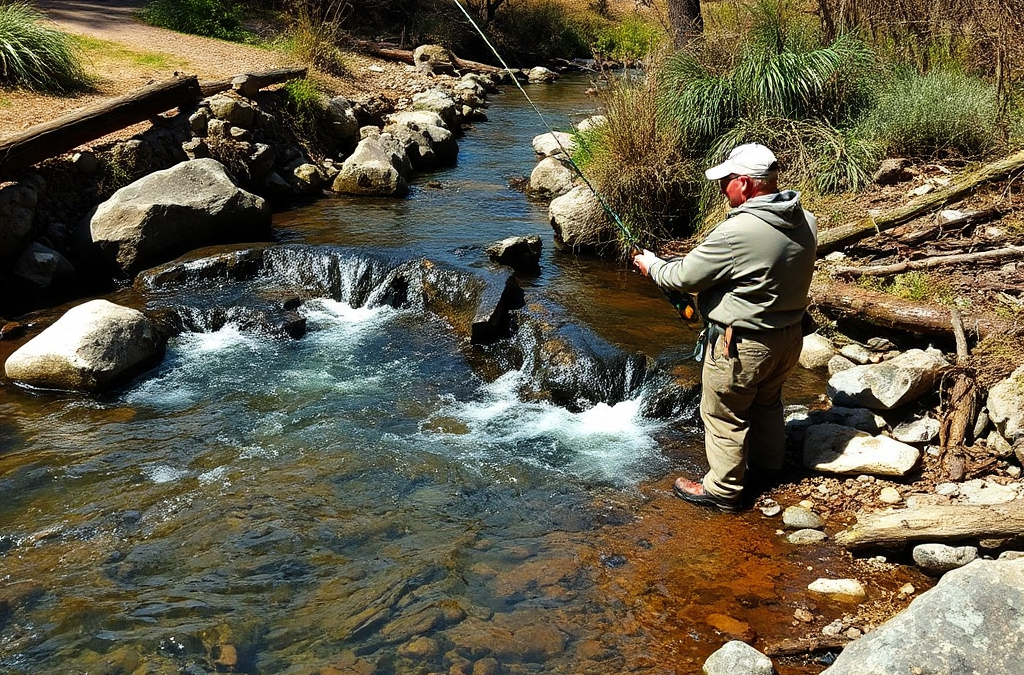
Fish effectively in small streams by staying concealed, reading current seams, and presenting a small bait or lure upstream so it reaches likely holding water naturally. Move slowly along the bank, keep your profile low, and avoid casting shadows across pools, undercut banks, and pocket water. Start with the nearest productive cover before wading, because careless movement can scatter fish that you have not yet seen. Match lure size to the stream’s forage and use lighter line when clear water makes fish cautious, while allowing enough strength for woody cover. If several casts fail, change the angle, depth, or presentation before abandoning the spot.
Read Small-Stream Water Before Casting
Small streams reward observation because limited depth and narrow banks concentrate fish in a small number of usable lies. Look first for current seams, plunge pools, undercut banks, submerged roots, large rocks, and the softer water behind obstructions. A trout, bass, panfish, or other stream resident does not need to occupy the deepest water available; it needs a position that provides food while reducing the energy required to hold in the current.

Current seams are especially valuable. The faster water carries insects and other food, while the slower edge gives a fish a place to wait. Cast so the offering enters the seam and drifts or swims toward the resting area. A pool below a shallow riffle may hold fish at its head, along the side edges, and near the deeper tailout, but those locations should not be treated as interchangeable. The head often has more oxygen and incoming food; the tailout may be easier to fish but more exposed.
Do not assume every attractive bank is productive. A shaded undercut with no meaningful current can be less useful than a plain-looking gravel edge connected to moving water. Watch for surface dimples, fleeing minnows, insect activity, foam lines, and darker shapes before committing to a cast. In clear water, fish may be visible only when you stop moving and let your eyes adjust.
A practical reading sequence is simple:
- Identify the strongest cover or depth change.
- Find the current line that delivers food to it.
- Estimate where a fish can hold with minimal effort.
- Plan the cast before stepping closer.
The common mistake is fishing the most obvious feature repeatedly while ignoring the water that feeds it. Small-stream success comes from connecting cover, current, and depth rather than casting randomly at every ripple. For a broader look at how to fish effectively in small streams, treat water reading as the first decision, not something done after several failed casts.
Approach Fish Without Spooking Them
Stealth often matters more in a narrow stream than lure selection. Fish can detect footsteps through the bank, see a bright shirt above the water, or react to a shadow crossing a shallow pool. Approach from downstream when the current and bank access allow it, because fish generally face into moving water and are less likely to see you from behind.
Stay low, use bank vegetation as concealment, and avoid standing at the edge of a pool before you have made the first cast. The nearest water is frequently the most overlooked opportunity. An angler who wades immediately to reach the far bank may pass directly through the holding water and ruin several casts that would have been available from shore. Fish the water at your feet, then the near seam, before entering the stream.
Wading has a clear tradeoff. It may improve casting angles and let you reach a shaded bank, but it also creates vibration, displaces silt, and limits the water that can be fished afterward. If you must wade, cross once at a shallow, low-value section and continue working upstream. Avoid repeatedly crossing through pools or riffles that feed the next area.
Clothing and movement should match the surroundings rather than draw attention. Neutral colors are useful in open terrain, but posture and motion usually matter more than exact shade. Keep rod movements compact, and position yourself so the sun is not casting your outline across the target. After a fish is hooked, move it away from heavy cover promptly, yet handle it carefully and follow local release or harvest rules.
Many anglers blame a refusal on the lure when the real problem is their approach. If fish stop rising, scatter from the bank, or appear only after you leave a pool, reduce movement and lengthen the distance between you and the target. The most effective change may be taking two steps backward rather than tying on a new offering.
Choose Baits, Lures, and Presentations
Small-stream tackle should be compact, controllable, and suited to the species and regulations of the water. Small spinners, compact jigs, miniature soft plastics, flies, and natural baits can all work when they reach the fish without excessive splash or drag. The best choice depends on water clarity, current speed, available forage, target species, and whether the stream permits the selected bait or hook arrangement.
In clear, low water, a smaller and less intrusive presentation is usually a sensible starting point. Cast upstream or across-current, then manage the line so the offering travels at a believable speed. For a drifting bait or fly, excess line creates drag and pulls it unnaturally across the seam. For a spinner or small artificial lure, retrieve just fast enough to maintain action while keeping it near the productive depth.
In stained or slightly elevated water, visibility may be reduced, so a contrasting profile, vibration, or scent can make the offering easier to find. That does not mean using the largest lure available. A large bait can look unnatural in a tiny channel and may snag frequently around branches and rocks. A modestly heavier option may be more useful when increased flow prevents a lighter offering from reaching the strike zone.
Work the water from near to far and shallow to deep when possible. Begin with a quiet cast to the closest seam, then extend the distance. Change one variable at a time: angle, depth, speed, or lure style. If a fish follows without striking, slow the retrieve or alter the angle. If the offering repeatedly catches bottom, raise it slightly or choose a lighter presentation; constant snagging wastes time and disturbs the pool.
A frequent misconception is that more casts automatically produce more fish. Repeatedly running the same lure through the same lane teaches you little and may alert every fish nearby. A better method is to make a few controlled presentations, observe the response, and then adjust the variable most likely to be wrong. That approach also complements small-stream fishing methods that prioritize natural movement over maximum casting distance.
Build a Productive Small-Stream Sequence
A repeatable sequence prevents rushed decisions and helps preserve unworked water. Begin at the downstream end of a promising stretch and progress upstream, allowing the current to carry noise and disturbance away from the water you plan to fish. At each feature, pause long enough to identify the best holding position, then make the least disruptive cast that can reach it.
Use the first few casts to cover different lanes rather than repeat one trajectory. A pool may require a short upstream drift along the near edge, a cast toward the head, and a controlled presentation beside the far cover. If the stream is extremely narrow, a single cast may cover most of the fishable water; in that situation, accuracy and stealth matter more than experimentation.
Keep a simple mental record of what the stream is showing. If fish respond near the bottom but ignore a fast-moving lure, shift toward a slower or deeper presentation. If strikes occur beside wood, prioritize similar cover upstream. If several pools are empty but riffle edges contain activity, the current may be delivering food there or the water temperature may be influencing fish location.

Use this compact field checklist before leaving a stretch:
- Were the nearest holding spots fished before wading?
- Did the presentation reach the correct depth and current speed?
- Was the failure caused by location, visibility, movement, or lure action?
- Did changing the angle produce a different response?
The wrong sequence is to walk quickly, cast only to the far bank, and change tackle after every empty pocket. That pattern hides the actual cause of failure. A deliberate upstream progression gives you a clearer comparison between water types and makes it easier to repeat what worked on the next trip.
Adjust for Conditions and Common Mistakes
Water level, clarity, light, temperature, and recent disturbance change how fish use a small stream. After rain, increased flow can move fish tight to banks, behind rocks, or into slower side channels, while clear falling water may make them cautious and highly aware of movement. Bright conditions often favor shade and deeper cover; overcast conditions may let fish spread into shallower feeding lanes.
Do not treat these patterns as guarantees. A cold, shaded run can still be empty if it lacks food or adequate depth, and a shallow riffle can be productive when insects or minnows are active. Check the water itself rather than relying only on a calendar. A small thermometer can provide useful context, but it should inform observation rather than replace it.
Common failures include using line that is unnecessarily visible, wading before fishing the bank, casting directly onto the fish, and retrieving too quickly for the current. Another mistake is carrying too much tackle and changing gear without diagnosing the presentation. Light equipment improves control and enjoyment, but ultralight line is a poor choice when hooked fish will immediately reach roots or jagged rocks. Select the lightest practical setup, not the lightest setup available.
Stream etiquette and conservation also affect future fishing. Avoid trampling spawning areas, leave gates and access points as you found them, pack out discarded line, and check current rules for seasons, size limits, bait restrictions, and protected waters. If releasing a fish, minimize air exposure and handle it with wet hands where appropriate. A short session with careful movement is preferable to exhausting one pool through repeated disturbance.
When conditions are difficult, prioritize location and stealth before adding complexity. A precise cast to a shaded current seam with a simple lure is often more productive than an elaborate rig presented from the wrong position. Record the water level, clarity, successful depth, and approach used; those observations turn one outing into a practical plan for the next.
For current seasons, access rules, bait restrictions, and species-specific guidance, consult the wildlife or fisheries agency responsible for the stream you plan to fish. Local regulations can vary substantially between nearby waters, so official information should take priority over general tackle advice.
Frequently Asked Questions
Should I fish upstream or downstream in a small stream?
Working upstream is usually useful because fish commonly face into the current and disturbance moves away from water you have not yet fished. Downstream approaches can still work when bank access, wind, or target behavior makes them more practical.
What lure size works well in a small stream?
Start with a compact lure that matches the stream’s forage and current speed. Downsize in clear, low water; use a slightly heavier or more visible option only when flow or clarity prevents the smaller offering from reaching fish.
Where should I cast first?
Fish the nearest productive water first, especially undercut banks, pocket water, pool heads, and current seams. Casting to the far bank before checking the water at your feet often causes unnecessary wading and missed opportunities.
How can I avoid spooking fish in clear water?
Approach from downstream, stay low, keep shadows off the pool, and limit wading. Make quiet casts from farther away and avoid repeatedly crossing through likely holding water.
What should I change when fish follow but do not strike?
Change one factor at a time. Slow the retrieve, alter the casting angle, adjust depth, or reduce lure size. A follow often indicates that location and general profile are acceptable but speed or movement needs refinement.
Further Reading
Authoritative Sources
- Academy of Nutrition and Dietetics
eatright.orgProfessional nutrition guidance, healthy eating resources, and practical dietitian-reviewed advice.
- U.S. Department of Agriculture
usda.govOfficial food, nutrition, agriculture, and consumer guidance from the USDA.
- NIH Office of Dietary Supplements
ods.od.nih.govResearch-based fact sheets on nutrients, supplements, dietary intake, and safety considerations.
- International Society of Sports Nutrition
sportsnutritionsociety.orgEvidence-informed sports nutrition resources and position stands for active people and athletes.
Conclusion
Effective small-stream angling is built on sequence and restraint: read the current, approach without advertising your presence, fish nearby water before wading, and present a compact offering at a believable speed. Give each pool a logical series of casts instead of repeating one lane, and diagnose an empty stretch by checking location, depth, clarity, and movement before changing tackle. Conditions can shift fish from riffles to banks or from shallow feeding lanes to deeper cover, so observation should guide each adjustment. Check local regulations before fishing, protect fragile stream habitat, and record what worked. On your next outing, begin with one promising seam, make the quietest accurate cast available, and let the stream’s structure determine your next move.

