
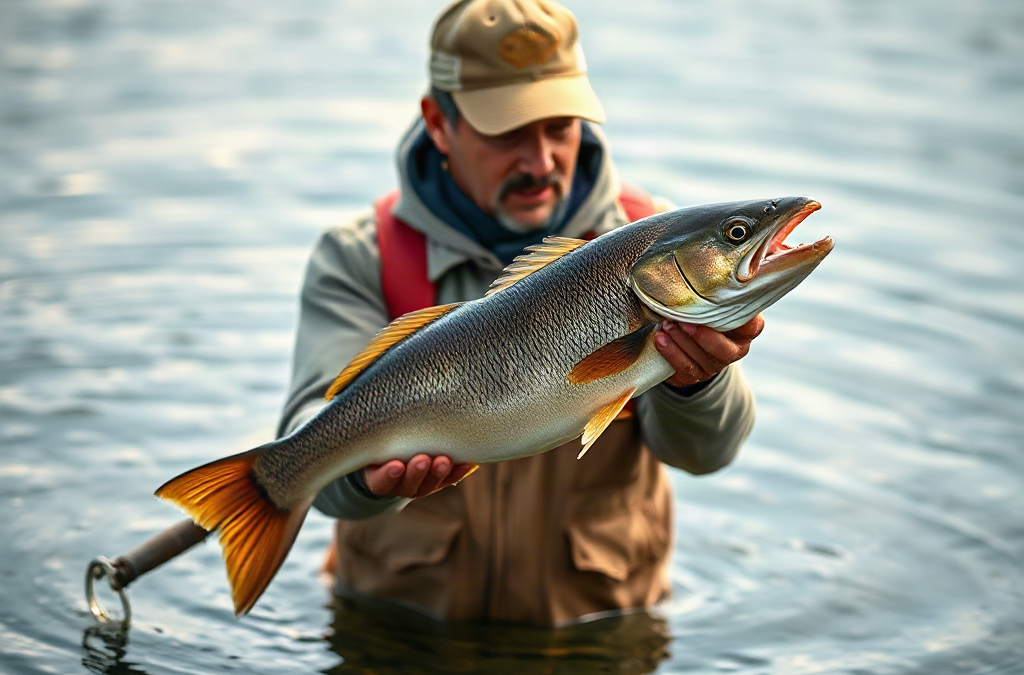
Improve your fishing skills through observation by watching water movement, fish activity, weather changes, and line behavior before changing locations or tackle. Spend the first few minutes identifying current seams, depth transitions, visible forage, shade, and surface disturbances, then use those clues to choose where and how to present your bait. During each retrieve, notice where bites occur, how the lure feels, and whether missed strikes follow a repeatable pattern. Change only one variable at a time so you can connect the result to depth, speed, color, or position. Record productive conditions rather than relying on memory, which often favors the catch but forgets the circumstances that produced it.
Read the Water Before Making the First Cast
Water reveals where fish can feed efficiently, avoid excessive current, and reach comfortable depths. Before assembling a rod or choosing a lure, scan the area from a position that does not cast your shadow across likely holding water. Look for current seams, points, drop-offs, submerged vegetation, shade lines, inflows, windblown banks, and changes in water color. These features matter because they concentrate food or give fish a place to wait without spending unnecessary energy.

Moving water deserves especially careful attention. Fish often hold beside the fastest flow rather than directly within it. A visible line where smooth and turbulent water meet may mark a current seam, while a patch of calmer water behind a boulder can provide a resting pocket. In a river, placing a bait upstream so it passes naturally along the edge of that pocket is usually more informative than repeatedly casting into the strongest current. If the bait is swept through too quickly, the presentation may never enter the fish’s practical feeding window.
On lakes and ponds, surface appearance can help you infer underwater structure. A change from pale to dark water may indicate greater depth, vegetation, or a different bottom composition. Wind can push plankton and small forage toward one shoreline, but a heavily windblown bank may also be difficult to fish accurately. Beginners commonly choose the calmest, easiest casting position. A more experienced observer compares casting comfort with the possibility that food has accumulated on the rougher side.
Visibility imposes limits. You cannot reliably identify depth or bottom composition from surface color alone, particularly in stained water or under changing light. Confirm visual impressions with controlled casts. Count a sinking lure down, feel for changes between rock, mud, wood, and vegetation, or use a float to test depth where permitted and appropriate. Treat the first casts as measurements rather than immediate attempts to cover as much water as possible.
A useful pre-cast scan follows a short priority order:
- Movement: Locate current, wind lanes, eddies, or water entering the area.
- Edges: Identify boundaries between shallow and deep water, shade and sunlight, or weeds and open water.
- Cover: Note docks, timber, rocks, vegetation, and overhanging branches without ignoring snag risk.
- Access: Choose a casting angle that reaches the feature while allowing a controlled retrieve and safe landing route.
The common mistake is seeing an attractive object, such as a dock or fallen tree, and assuming fish must be there. Cover becomes more valuable when it intersects with depth, moving water, forage, or shade. Prioritize combinations of clues over isolated features. That distinction turns water reading from guesswork into a testable choice.
Use Wildlife, Forage, and Weather as Fishing Clues
Activity around the water can indicate where the food chain is concentrated, but each clue needs context. Diving birds, fleeing minnows, dimpling insects, and sudden surface splashes may reveal active feeding. They do not necessarily identify the species below or guarantee that a particular lure will work. The practical skill is separating a repeatable pattern from a single unexplained disturbance.
Suppose small fish repeatedly break the surface near the outer edge of a weed bed. That may indicate predators pushing forage upward, especially if the disturbance moves or recurs. A lure matched to the approximate size and swimming level of the forage is a sensible first test. By contrast, one isolated splash near shore could be a jumping fish, falling branch, turtle, or bird. Casting immediately at every sound scatters attention and often causes the angler to abandon a better pattern.
Bird behavior is most useful when it is sustained and specific. Birds circling without diving provide weaker information than birds repeatedly entering the water in one compact area. Wading birds along a shallow edge may indicate abundant small prey, although their presence can also make nearby fish cautious. Observe from a distance and avoid crowding wildlife. Local access rules and protected areas still govern where you may stand, wade, anchor, or cast.
Weather changes how visible clues should be interpreted. Bright sun can create shade lines around docks, trees, banks, and vegetation, potentially tightening fish to cover. Cloud cover may reduce those defined boundaries and allow feeding fish to roam. Wind breaks up the surface, reduces underwater visibility, and moves food, yet strong gusts can make line control and bite detection worse. The productive choice is not automatically the windiest bank; it is a location where the wind creates an advantage you can still fish effectively.
Temperature trends can alter activity, but avoid assuming that one warm afternoon or cold morning dictates the entire day. Shallow areas may change faster than deep water, and incoming water can differ from the surrounding lake or river. Compare locations rather than relying on a broad seasonal rule. If a sun-warmed pocket contains visible forage but no predator activity, test the adjacent depth break before concluding that the area is empty.
Anglers practicing how to improve your fishing skills through observation should watch for agreement among signals. Forage, favorable structure, manageable wind, and repeated activity form a stronger case than any clue alone. The main failure is converting a plausible sign into certainty. Use environmental evidence to choose the next cast, then let contact, follows, and bites confirm or reject the interpretation.
Interpret Every Cast, Follow, Bite, and Miss
Each presentation supplies information even when no fish reaches the net. The lure may contact bottom, collect vegetation, pass untouched through open water, draw a visible follow, produce a light tap, or trigger a strike at a particular point. Observant anglers connect those events to location and presentation instead of labeling the cast simply successful or unsuccessful.
Line behavior often communicates more than the rod tip. A sinking bait that stops before the expected count may have landed on a ledge, vegetation, or a fish. A line that jumps sideways can indicate a pickup, while steady bowing may come from wind or current. Keep light contact without pulling the bait unnaturally. With slack-line techniques, watch the line where it enters the water and compare unusual movement with the normal sink on earlier casts.
Missed strikes deserve diagnosis rather than an automatic lure replacement. A fish that follows but turns away near the surface may have detected an unnatural speed, profile, or abrupt direction change. Repeated short strikes can mean the fish are contacting the tail of the bait, but they may also result from small fish, poor hook exposure, or excessive retrieve speed. One miss proves little. Several similar responses at the same depth or during the same retrieve phase justify a controlled adjustment.
Change one meaningful variable and repeat the cast through comparable water. If you slow the retrieve, switch color, reduce lure size, and move position simultaneously, a bite cannot tell you which adjustment mattered. Begin with the variable most clearly suggested by the observation. Fish following without committing may justify a speed or direction change. Bottom contact far below the strike zone calls for a shallower presentation. Bites that occur only beside cover call for better casting angles before a new bait.

A practical sequence is to ask four questions after a notable event: Where did it happen? How deep was the presentation? What was the bait doing? What changed immediately beforehand? For example, a strike beside a stump may actually have occurred when the lure accelerated free of a branch. Reproducing the speed change could be more valuable than merely casting at other stumps.
Hooking and landing behavior also belongs in your observations. If fish repeatedly come free, inspect whether the hook is sharp, exposed, and suitable for the bait rather than assuming the fish are barely biting. Notice whether slack develops when a fish changes direction or jumps. Equipment adjustments matter, but technique may be the cause. The purpose of how to improve your fishing skills through observation is not to overanalyze every twitch; it is to identify repeated cause-and-effect relationships that guide the next controlled decision.
Build an Observation Routine That Produces Reliable Patterns
A repeatable routine prevents memorable catches from overshadowing the conditions that produced them. Record enough detail to reconstruct a useful pattern: location type, date, approximate time, water clarity, wind direction, visible forage, depth, presentation, retrieve speed, and where the bite occurred. Exact measurements are not always available, but consistent estimates are more useful than scattered, highly detailed notes.
Keep records immediately after a meaningful change or at the end of a short fishing period. Memory tends to preserve the largest fish while losing the failed casts, weather shifts, and small adjustments surrounding it. A waterproof notebook, phone note, or voice memo can work. The best format is the one you can use without disrupting fishing or handling a fish unsafely. Complete the note after the fish has been released or stored according to applicable rules.
Separate direct observations from interpretations. “Three bites came where the weed edge met deeper water” is an observation. “All fish wanted deep weeds” is an interpretation that may be premature. This distinction reduces confirmation bias. On the next trip, test the suspected pattern in several similar places. If bites recur at weed-depth intersections but not along uniform vegetation, the pattern gains credibility. If they do not, consider changes in light, wind, forage position, or presentation.
Short observation sessions can be more useful than making random changes throughout the day. Fish one defined feature for a set period while holding lure depth and retrieve reasonably constant. Then alter one factor or move to a contrasting feature. A bank angler might compare a shaded point, an open flat, and an inflow. A boat angler could compare the shallow top of a break with its deeper edge. The goal is not rigid experimentation; changing fish and weather make perfect controls impossible. The goal is to reduce unnecessary variables enough to recognize direction.
Signs that the routine is working include faster location decisions, fewer unexplained lure changes, repeated bites from comparable features, and notes that help predict where activity shifts as conditions change. Warning signs include forcing every catch into an old pattern, ignoring contradictory evidence, or spending so much time recording that presentations become careless. Advanced observation is selective: capture details that influence decisions and discard trivia that does not.
End each outing with one working conclusion and one unanswered question. You might conclude that bites clustered on the down-current side of rock while asking whether depth or reduced current mattered more. That question gives the next trip a focused test. Over time, this cycle creates local knowledge grounded in what the water and fish actually showed, not in a fixed rule borrowed from a different season or body of water.
Frequently Asked Questions
How long should I observe the water before casting?
Spend roughly five minutes scanning obvious movement, edges, cover, forage, and access angles. Extend that time when fish are visibly active or when unfamiliar current makes safe positioning difficult.
What should a beginner watch first?
Start with visible edges where depth, current, shade, or vegetation changes. These boundaries are easier to recognize and test than subtle clues such as minor temperature differences.
Does seeing fish mean I should cast directly at them?
Not always. Casting onto fish can startle them. Place the bait beyond or upstream of their position when possible, then bring it through their path naturally.
Which details belong in a fishing log?
Record the feature fished, time, wind, clarity, depth, visible forage, lure or bait, presentation speed, and exact point in the retrieve where contact occurred.
When should I change lures after getting no bites?
First verify that the presentation reaches a plausible strike zone and passes productive structure. Change one factor when your casts provide a specific reason, such as follows without strikes or repeated bottom fouling.
Conclusion
Better observation comes from linking visible conditions to what happens during the presentation. Begin by locating intersecting edges, current, cover, depth, and forage rather than casting at the first attractive object. Watch the line and lure closely enough to identify where follows, taps, snags, and committed strikes occur. When a pattern appears, adjust one variable and test it in comparable water.
Keep brief notes that separate facts from assumptions, then use the next outing to challenge your interpretation. Prioritize repeated evidence over isolated splashes or a single lucky catch. Your next practical step is simple: spend five quiet minutes reading the water, select one feature for a controlled test, and write down where the first meaningful response occurs. That small routine gradually makes location and presentation choices more deliberate.

