
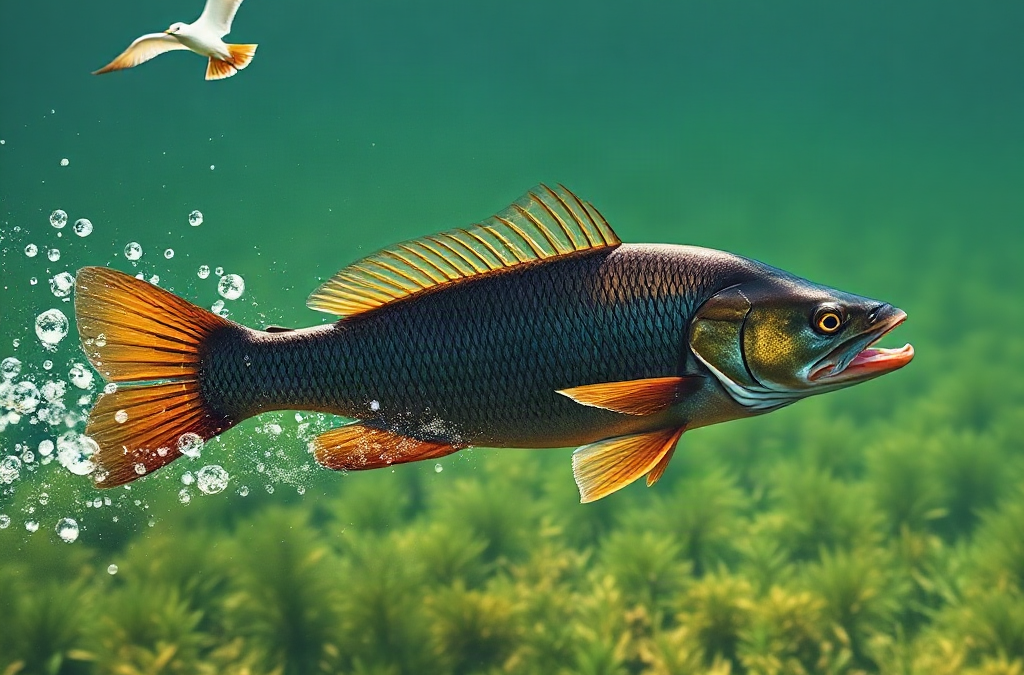
Common signs that fish are present in the area include schooling baitfish, surface disturbances, diving birds, fresh swirls near cover, and concentrated activity around current breaks or underwater structure. Baitfish often reveal a predator’s location because fleeing minnows may bunch, scatter, or flick across the surface. Birds working repeatedly over one patch can confirm feeding below, while isolated ripples may simply result from wind or insects. Check whether several clues occur together, then position your cast beyond the activity and retrieve through the likely feeding lane. Treat sonar marks, forage presence, water movement, and repeated strikes as stronger evidence than a single splash.
What you’ll learn
This guide covers the following practical points:
- Surface Activity That Reveals Feeding Fish — Surface disturbances are useful when they show purposeful movement rather than random water noise.
- Baitfish, Birds, and Aquatic Food Clues — Visible forage is one of the strongest clues because predator fish rarely remain far from dependable food for long.
- Structure, Current, and Water Conditions — Fish often reveal their presence through the places they select, even when they remain invisible.
- A Practical System for Confirming Fish Presence — Confirming fish requires a short observation period followed by deliberate testing.
Surface Activity That Reveals Feeding Fish
Surface disturbances are useful when they show purposeful movement rather than random water noise. A sharp splash followed by several smaller flicks may indicate a predator pushing baitfish upward, while a broad boil beside a weed edge can suggest a fish turning beneath the surface. Repeated swirls in the same lane deserve more attention than one isolated ring because feeding fish often return to a productive route.
Look closely at the shape, frequency, and location of the disturbance. Baitfish usually create quick, scattered flashes or tiny dimples as they escape. Larger fish may leave a heavier boil, a rolling back, or a short wake that changes direction. A fish traveling through shallow water can also displace vegetation, cloud the bottom, or make reeds tremble. These details help distinguish fish activity from wind, falling leaves, turtles, or insects.
The position of the disturbance matters as much as its appearance. Fish commonly feed along the outside of grass, beside a dock shadow, at the mouth of a creek, or where shallow water drops into a deeper channel. Cast past the suspected fish and bring the presentation across the area rather than landing directly on the splash. A direct impact can scatter feeding fish, especially in clear, calm water.
Surface signs are not proof by themselves. Wind can push floating debris into circular patterns, and carp or mullet may disturb water without responding to the same presentations as bass or other target species. A useful confirmation is a combination of signs: repeated activity, visible forage, suitable cover, and a water position that gives fish a feeding advantage. You can connect observations with common signs that fish are present in the area before committing to a long stay.

Baitfish, Birds, and Aquatic Food Clues
Visible forage is one of the strongest clues because predator fish rarely remain far from dependable food for long. Small minnows may gather around shade, current seams, submerged vegetation, or warm-water edges. Watch for flashes beneath the surface, baitfish packed tightly against cover, or sudden movement in which the school changes direction at once. A coordinated burst often means something larger has entered the area.
Different bait behaviors suggest different fishing responses. Calm baitfish spread loosely and may indicate that no predator is actively pressing them. Bait that repeatedly hugs the bank may be avoiding open water or responding to current. When minnows scatter in several directions, the disturbance may be caused by a predator, but it can also result from a passing boat or a bird. Waiting briefly and checking for a second event prevents a weak clue from controlling the entire plan.
Bird activity can extend your view beyond the water’s surface. Terns, gulls, herons, and cormorants may gather where forage is concentrated, but each bird pattern needs interpretation. Repeated diving over one area is more meaningful than a bird merely resting on a piling. Shorebirds working a shallow flat may be feeding on insects or crustaceans rather than signaling game fish. Birds are a location clue, not a guarantee that the fish below will eat your chosen bait.
Match the presentation to the food fish appear to be targeting. If small baitfish are fleeing near the surface, a compact minnow imitation worked quickly may be more appropriate than a large, slow offering. If fish are holding beneath a cloud of forage, count the lure down and retrieve it at the level where the activity is occurring. A common mistake is to choose a favorite bait before identifying the available food. Let the size, speed, and depth of the forage narrow the options.
- Strong clue: repeated bait movement paired with boils, birds, or strikes.
- Moderate clue: visible forage near cover without obvious predator activity.
- Weak clue: a single bird, splash, or baitfish flick with no repeat pattern.
Structure, Current, and Water Conditions
Fish often reveal their presence through the places they select, even when they remain invisible. Points, submerged trees, rock piles, creek mouths, bridge pilings, weed lines, and abrupt depth changes give fish ambush positions or protection from current. The most promising structure is usually not simply the largest object; it is the feature that combines cover, access to food, and a nearby escape route.
Current creates especially useful holding positions. Fish may rest behind a rock, piling, bend, or ledge where water pressure is lower, then move into faster flow to intercept food. Look for seams where smooth water meets broken water, foam lines that remain in place, or floating debris collecting along an edge. A lure that crosses from slack water into the seam can imitate food being carried into the strike zone. Heavy current may require a lower, more controlled presentation, while gentle flow can favor a moving bait.
Water color and temperature changes also influence where signs appear. A clear-to-stained transition can concentrate both prey and predators because it combines visibility with cover. A warm inflow may attract bait during a cool period, whereas excessive heat or low oxygen can push fish toward deeper or better-oxygenated water. These relationships vary by species and season, so treat them as location hypotheses rather than fixed rules.
Sonar can confirm structure and depth, but an empty screen does not always mean empty water. Fish may blend with the bottom, sit inside vegetation, or pass through the transducer’s narrow cone between readings. Conversely, an attractive sonar mark without forage, cover, or recent activity may not be worth hours of casting. Compare what the electronics suggest with what the shoreline, current, and bait are doing. The best areas often show agreement between several independent clues.
When fishing a new area, prioritize features in this order: visible forage, a feeding position, suitable depth, and manageable access. A dramatic piece of structure in dead water may outperform a modest edge where food is actively moving. That comparison keeps the search grounded in fish behavior rather than appearance alone.
A Practical System for Confirming Fish Presence
Confirming fish requires a short observation period followed by deliberate testing. Before casting, spend a few minutes scanning the water, watching bait, checking wind direction, and noting current or depth changes. Mark where activity occurs relative to cover. This prevents random casting across an entire bank and gives each presentation a clear purpose.
Use a simple evidence ladder. First, find a potential food source or holding feature. Second, look for movement that fits feeding behavior. Third, make quiet casts that cover different depths or angles. Fourth, judge the response: follows, short strikes, bait scattering, or repeated contact can show that fish are nearby even when hookups do not happen. If nothing changes after several purposeful presentations, relocate or alter one variable rather than cycling through unrelated lures.

Four checks before staying put
- Locate the food: identify minnows, insects, crayfish habitat, or other available prey.
- Find the advantage: look for shade, current relief, a drop-off, or cover that lets fish feed efficiently.
- Cover the likely level: test surface, midwater, and bottom positions instead of assuming one depth.
- Verify repetition: wait for recurring activity, additional marks, or a biological response to the presentation.
A real-world example might involve a calm reservoir arm where two small splashes appear beside standing timber. Rather than repeatedly casting at the exact splash, work the outside edge, then probe the adjacent depth change. If bait continues flicking and the lure receives follows, the area deserves more time. If the splashes stop, no forage appears, and the water is warming rapidly, the original clue may have been incidental.
Boat anglers can reposition to approach a feeding lane from down-current or downwind, while bank anglers may need to choose an angle that keeps the bait moving naturally. Stealth matters in shallow water: reduce unnecessary footsteps, avoid casting a shadow across the target, and make the first cast count. The common signs that fish are present in the area become more useful when they determine where and how you approach, not merely whether you stop.
Common Misreads That Waste Fishing Time
The most costly mistake is treating every visible disturbance as a target fish. Wind-driven rings, feeding turtles, jumping carp, and bait reacting to a boat can all look convincing for a moment. Ask whether the movement repeats, whether it occurs near food or structure, and whether its size and direction fit the species you are pursuing.
Another weak assumption is that fish must remain directly beneath birds or surface action. Predators may push forage away from the original disturbance, and birds can drift with wind while feeding fish move with current. Cast around the activity, not only into its center. Cover the escape routes along a bank, seam, or weed edge and watch for where bait reappears.
Anglers also abandon productive water after one quiet cast. Fish may be holding deeper, facing into current, or responding only to a slower presentation. Change depth, angle, or retrieve speed one at a time so you know what produced a response. The opposite error is staying too long because a spot looks ideal. A beautiful dock, point, or weed bed without forage or feedback should not receive unlimited attention.
Use a practical stop rule: move when the evidence is weak, the likely depth has been tested, and no bait movement or fish response appears after several controlled attempts. Stay when multiple clues continue, even if the first presentation fails. That judgment is more reliable than relying on a single splash, a favorite location, or the hope that fish will eventually become active.
Frequently Asked Questions
Do jumping fish always mean predators are nearby?
No. Fish may jump to remove parasites, feed on insects, or respond to changing conditions. Repeated baitfish scattering, boils, and activity near cover make the clue more convincing.
Are diving birds reliable signs of fish?
Diving birds can indicate concentrated forage, but they do not identify the species or depth of fish below. Watch whether the birds repeatedly work one area and pair that observation with bait or sonar evidence.
Where should I cast when I see a surface disturbance?
Cast beyond the disturbance and retrieve across the likely feeding lane. Landing directly on the fish can spook it, particularly in shallow, clear water.
Can fish be present when sonar shows nothing?
Yes. Fish can blend with the bottom, hide in vegetation, or pass outside the sonar cone. Combine electronics with structure, forage, water movement, and visible activity.
How long should I fish a promising-looking spot?
Stay longer when several clues agree or the area produces follows, strikes, or continuing bait movement. Move when repeated casts at the likely depths produce no response and the supporting signs disappear.
Additional Resources
Authoritative Sources
- Academy of Nutrition and Dietetics
eatright.orgProfessional nutrition guidance, healthy eating resources, and practical dietitian-reviewed advice.
- U.S. Department of Agriculture
usda.govOfficial food, nutrition, agriculture, and consumer guidance from the USDA.
- NIH Office of Dietary Supplements
ods.od.nih.govResearch-based fact sheets on nutrients, supplements, dietary intake, and safety considerations.
Conclusion
Finding fish becomes more consistent when you read several clues together instead of chasing every splash. Give the most weight to repeated bait activity, purposeful surface disturbances, diving birds that remain over one area, and structure that offers both cover and access to food. Current seams, depth changes, and sonar can refine the location, but none should override the absence of forage or fish response. Observe before casting, approach the feeding lane quietly, and test depth or retrieve speed methodically. If the evidence weakens after controlled attempts, move without regret. The goal is not to prove that a spot could hold fish; it is to identify whether fish are using it now and then present your bait where their behavior makes sense.

