
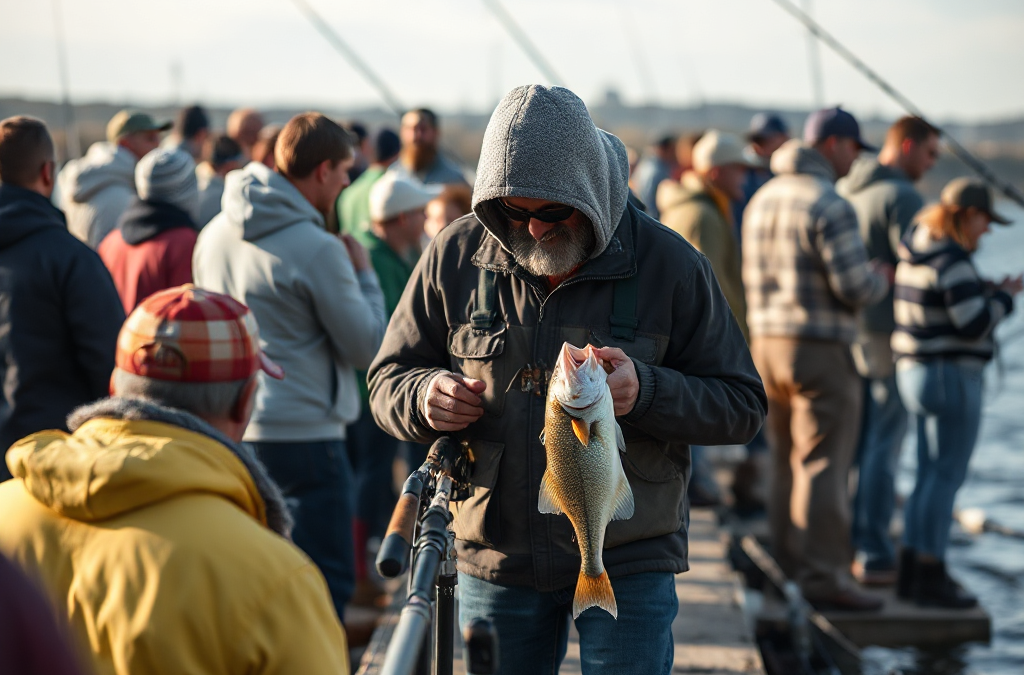
If your fishing spot is too crowded, protect your time and safety by checking whether another angler is already working the area, moving to a nearby secondary location, or returning during a quieter tide, weather window, or time of day. Crowding often reduces casting space, disturbs fish through repeated movement, and creates avoidable conflicts over access. Do not squeeze into a productive stretch without asking, crossing another person’s line, or casting over occupied water. Try a less obvious structure nearby, change your presentation, and keep a backup spot ready so leaving does not end the outing.
Decide Whether the Spot Is Still Fishable
A crowded fishing spot is not automatically a lost opportunity. The first decision is whether you can cast, move, and land a fish without interfering with another angler. A wide shoreline, large pier, or open reservoir bank may support several people if everyone has clear casting lanes. A narrow creek bend, small dock, or confined jetty usually becomes unproductive and unsafe much sooner.

Watch the pattern of activity before unpacking. Count the occupied casting angles, notice where lines enter the water, and look for people who are actively moving along the bank. If anglers are spaced far apart and retrieving in consistent directions, there may be room at the edge. If lines cross, people are casting over one another, or anglers are guarding a small piece of structure, adding yourself will probably create more frustration than fishing.
Fish may also respond to the disturbance created by a busy area. Footsteps on a shallow bank, repeated casts, dropped tackle, boat traffic, and people standing directly over clear water can push wary fish toward deeper cover or less obvious edges. That does not mean every crowded location is poor; a busy access point can still produce when current, shade, bait movement, or a feeding period concentrates fish there. The useful question is whether the fishable water left open is worth the reduced space.
Use this quick check before committing:
- Is there a safe casting lane that does not cross another line?
- Can you leave without stepping through someone else’s gear or fishing position?
- Is enough shoreline or structure available for more than one person?
- Would your presence force another angler to change a working pattern?
If two or more answers are unfavorable, treat the location as occupied rather than trying to win a small patch of water. More information about what to do if your fishing spot is too crowded is useful, but the immediate priority is space, safety, and a workable cast.
Move Without Wasting the Rest of the Outing
The best move is often not a long drive to a completely different waterway. Look first for a nearby alternative that shares the same fish-holding conditions. If the main point is crowded, check the secondary point, the next creek mouth, the shaded side of the bank, or a deeper outside bend. Fish commonly use connected habitat, so a short relocation can preserve the same depth, cover, and food source without the conflict.
Move according to structure rather than appearance. A quiet stretch with no visible anglers is not necessarily better if it has no depth change, current break, vegetation, rock, or access to deeper water. Conversely, an unattractive patch beside a busy area may hold fish because anglers overlook it. For example, if people are packed around a prominent fallen tree, a small submerged branch or soft-bottom pocket nearby may receive less pressure while still offering cover.
Keep your first relocation simple. Carry only the tackle needed for the next presentation, secure hooks and loose line, and walk well away from occupied casting lanes before stopping. On a boat, idle past the productive area rather than dropping an anchor directly on the edge someone is working. A quiet approach matters because moving through shallow water can disturb the very fish you hoped to reach.
There is a tradeoff between staying and relocating. Remaining at a crowded spot saves time and may keep you near known fish, but it limits casting angles and increases the chance of tangled lines. Moving costs a few minutes and may require experimentation, yet it gives you control over your retrieve, landing area, and pace. Choose relocation when the crowd prevents a clean cast or when your planned technique depends on covering water.
After moving, give the new area a structured trial rather than abandoning it after three casts. Fan-cast different angles, vary depth, and check both the visible feature and the nearby transition. Signs that the move is working include fewer snags, cleaner retrieves, bait activity, or a change in depth. If the area produces no useful clues after a deliberate pass, move again instead of blaming the lure.
Use Timing and Presentation to Avoid Pressure
Changing when you fish can solve a crowd problem more effectively than changing equipment. Popular banks often fill during comfortable midday hours, weekends, holidays, or predictable weather breaks. Early morning, late afternoon, a weekday, or a less convenient access period may provide the same water with fewer competing casts. The best timing depends on the species, season, weather, water level, and local access rules, so treat quiet hours as an experiment rather than a guarantee.
Timing also changes how fish use a pressured location. A point that is crowded and noisy at noon may become more productive after people leave and surface disturbance drops. In clear water, fish may hold tightly to shade or deeper edges while anglers are present, then move onto the shallow area during lower-light conditions. In moving water, a change in current can matter more than the number of people. Watch the water’s behavior instead of assuming the crowd alone explains every slow period.
When leaving is not practical, adjust your presentation to reduce competition. Rather than duplicating the most common cast toward the obvious cover, work the outside edge, bottom transition, or downstream side. A quieter lure entry and a slower retrieve may reach fish that have seen repeated fast-moving offerings. Downsizing can be useful in clear, heavily pressured water, while a heavier or more visible presentation may be needed when wind, current, or stained water prevents fish from tracking a subtle bait.
Do not confuse a different lure with a different opportunity. If every angler is casting the same visible bank, changing color while repeating the same angle may accomplish little. Change one meaningful variable at a time: distance from cover, depth, retrieve speed, or casting direction. For example, fishing parallel to a weed line can keep a lure in the strike zone longer than repeatedly casting straight into the crowded center.
Pressure can make patience useful, but patience has limits. Stay if you can identify a specific adjustment and observe a reason fish should remain nearby. Leave if the crowd removes your casting options, if disturbance is constant, or if you are only waiting because the area has a reputation. A famous spot is not automatically the best spot during the busiest part of the day.
Handle Shared Water With Good Etiquette
Courtesy is a practical fishing skill because poor communication can turn a crowded location into a dangerous one. Give the angler who arrived first reasonable priority over the water immediately in front of that person. Ask where lines are running, whether the shoreline is being rotated, and which direction people are moving. A short question such as “Which way are you working?” can prevent crossed casts and makes your intentions clear.
Leave a useful buffer around active anglers, especially where current carries floats or bait downstream. Do not cast over another person’s line, walk between an angler and the water, or stand directly behind someone during a cast. On a narrow bank, move behind the group only when there is a clear path and no risk of disturbing tackle. If a person is fighting a fish, stop casting and give room until the fish is landed or released.
Etiquette is not the same as surrendering every open place. Public access may allow several people to fish an area, but legal access does not remove the need for safe spacing. If the shoreline is large enough, take an outside position and fish a different angle. If it is too confined, ask whether the group is rotating or choose another area. A calm departure is usually better than arguing over an uncertain claim to a few yards of water.

Boat anglers need extra caution. Keep clear of anchored boats, avoid running directly through a drift, and do not use a wake to force people off a bank or dock. If you must pass through a fishing area, slow down, give space, and choose the route that creates the least disturbance. Regulations and local customs vary, so check the relevant fish-and-wildlife agency for access, boating, and species-specific rules.
Common mistakes include assuming silence means permission, treating a visible lure as an invitation to fish the same line, and criticizing another angler’s technique. Focus on whether your actions interfere. Respectful behavior protects the quality of the outing and makes it more likely that shared waters remain usable for everyone.
Build a Reliable Backup Plan
A backup plan turns crowding from a surprise into a routine decision. Before leaving home, identify two or three nearby options with different characteristics: perhaps a secondary bank, a public access point farther from the main parking area, and a location suited to a different species or technique. Record the practical details that affect the choice, including parking, walking distance, bank access, water depth, wind exposure, and whether a short visit is worthwhile.
Choose alternatives by function rather than by popularity. One location might be best for covering shallow water with moving lures; another may offer deeper water for a slower presentation; a third may be suitable when wind makes the first two difficult. This prevents a common failure mode in which every backup spot is simply another famous point that attracts the same crowd.
Use a simple departure threshold. Leave the original area when you cannot make a clean cast, when another angler’s line occupies the water you need, when safety space disappears, or when disturbance has clearly changed the conditions. Set the threshold before frustration builds. That makes the decision based on fishing quality rather than pride or sunk travel time.
Prepare for relocation by keeping tackle organized. A small selection of proven lures, spare leader, pliers, water, and a charged phone are more useful during a move than a fully opened tackle bag. Carry out line, bait containers, and packaging. A clean, quiet transition lets you test another area quickly and avoids creating problems at the next access point.
Keep notes after the trip. Write down when the crowd arrived, which nearby areas were open, how fish responded to pressure, and whether the alternative produced signs of life. Over time, these observations reveal patterns that map apps and reputation cannot show. The most dependable solution is often a flexible route: arrive early when the prime area matters, move when casting quality collapses, and return during a period when the water can be fished without forcing other people to accommodate you.
For local access, seasonal restrictions, boating requirements, and species regulations, consult the official fish-and-wildlife agency or parks department responsible for the water you plan to fish. Those sources are more reliable than informal claims about who can use a particular bank, dock, launch, or shoreline.
Frequently Asked Questions
Should I fish beside someone if there is open shoreline?
Only if you can maintain a clear casting lane and avoid interfering with the other person’s retrieve. Ask which direction they are working before setting up.
Is it better to leave immediately when a spot is crowded?
Not always. Stay briefly if the area is spacious and you can test a distinct angle, but leave when lines cross, casting space disappears, or disturbance dominates the water.
What nearby areas are worth trying?
Look for connected habitat such as a secondary point, creek mouth, outside bend, shade line, depth change, or less obvious cover near the main location.
Can changing lures help in a crowded spot?
It can, but changing casting angle, depth, or retrieve speed may matter more than changing color. Repeating the same cast with a new lure often produces little difference.
How can I avoid crowded fishing spots in the future?
Fish outside peak weekend hours, arrive before the busiest period, monitor access conditions, and keep several backup locations with different habitat and access demands.
Further Reading
Authoritative Sources
- Academy of Nutrition and Dietetics
eatright.orgProfessional nutrition guidance, healthy eating resources, and practical dietitian-reviewed advice.
- U.S. Department of Agriculture
usda.govOfficial food, nutrition, agriculture, and consumer guidance from the USDA.
- NIH Office of Dietary Supplements
ods.od.nih.govResearch-based fact sheets on nutrients, supplements, dietary intake, and safety considerations.
- International Society of Sports Nutrition
sportsnutritionsociety.orgEvidence-informed sports nutrition resources and position stands for active people and athletes.
Conclusion
A crowded fishing spot calls for a decision, not a contest. First protect casting space and safety; then judge whether the remaining water offers a realistic opportunity. If it does, work a different angle or depth without crossing another angler’s line. If it does not, move to nearby habitat, change the timing, or use a backup location designed for different conditions. Clear communication matters as much as lure selection, particularly on narrow banks, docks, and shared boat water. Keep a compact relocation kit, note when crowds develop, and set a departure threshold before frustration takes over. The next outing becomes easier when you treat access, fish behavior, and courtesy as connected parts of the fishing plan.

