
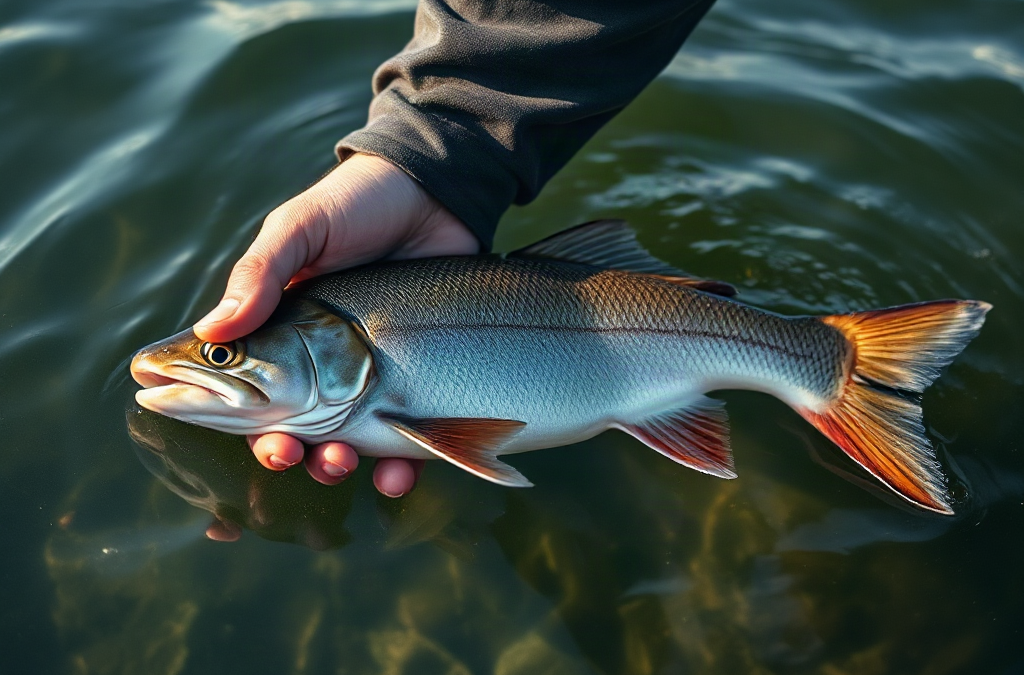
Handle fish safely by shortening the fight, preparing release tools before landing, keeping the fish in water, and removing the hook with minimal restraint. Wet your hands before contact, support the body horizontally, and never squeeze the abdomen, touch the gills, or suspend a heavy fish by its jaw. Cut the leader when removing a deeply embedded hook would cause more injury, and revive an exhausted fish in clean, well-oxygenated water until it can hold itself upright. Water temperature, capture depth, bleeding, and air exposure can still affect survival, so release is not guaranteed even when a fish swims away.
Prepare for Release Before the Fish Is Hooked
Safe handling begins before a strike because tackle choice and equipment placement determine how long a fish remains exhausted or exposed. Match the rod, line, leader, and drag to the likely species rather than using unusually light tackle for sport. A prolonged fight consumes energy and can leave a fish unable to maintain balance after release, especially when water is warm or current is strong.

Set out the tools needed for release before casting. Pliers or a hook-removal tool should be open and within reach, while a rubber-coated or knotless landing net should be positioned where it can be used with one hand. If a photograph is planned, prepare the camera first. Searching through a tackle bag while a fish lies on a hot deck turns avoidable delay into the most stressful part of the encounter.
Hook selection also changes the likely injury. Barbless hooks, or barbs flattened with pliers, generally come out faster and require less force. Circle hooks can reduce deep hooking in many bait-fishing situations when anglers avoid a hard hookset and instead allow steady line pressure to engage the hook. They are not appropriate for every lure or technique, but they can be a useful choice when swallowed bait is a recurring problem.
Build a compact release station around the conditions you actually fish. Useful items include long-nose pliers, line cutters, a knotless net, wet measuring equipment, and a camera secured against dropping. On a boat, clear loose tackle from the working area so the fish cannot strike exposed hooks. From shore, identify a low, stable place at the water before landing the fish rather than dragging it across rocks, sand, or vegetation.
A practical pre-cast check takes only a moment:
- Tools ready: Pliers and cutters can be reached immediately.
- Landing route clear: The fish can remain over water or in a wet net.
- Tackle appropriate: The outfit can bring the expected fish in promptly.
- Photo plan set: The camera is ready, or the photograph will be skipped.
The common mistake is treating release as a decision made after landing. Following how to handle fish safely to ensure their survival starts with preventing delays that cannot be recovered once the fish is out of water.
Land and Restrain the Fish Without Damaging It
A fish should be landed with steady pressure and controlled without crushing its body or removing its protective slime. Lead it headfirst into a knotless, rubber-coated net instead of chasing it repeatedly. Once netted, leave the fish submerged whenever practical and use the net as a temporary holding cradle rather than immediately lifting it onto the boat or bank.
Dry hands, gloves, carpet, sand, and rough netting can remove slime and scales. That outer layer is part of the fish’s physical defense, so wet bare hands before touching it and avoid wiping motions. Gloves may protect the angler from teeth or spines, but dry or abrasive gloves can be harder on the fish than carefully wetted hands. For hazardous species, prioritize personal safety and use species-appropriate tools rather than attempting an insecure grip.
Support a fish horizontally with one hand near the tail wrist and the other beneath the abdomen or pectoral area. Keep fingers away from the gill covers and never insert them into the gills. A small fish may tolerate brief lower-jaw control if its body remains supported, but a large fish should not hang vertically from its jaw. Its weight can strain the jaw and internal tissues even when no damage is visible.
For example, an angler landing a sizable bass from a boat should keep it in the net while clearing the lure, wet both hands, then lift it horizontally only when measurement or a photograph is ready. A trout caught from a shallow stream is often better handled without leaving the water at all: kneel at the edge, keep the fish facing into gentle current, and remove the hook while it remains supported by the net.
Do not squeeze a struggling fish to make it stop moving. Lower it back into the water or net, allow it to settle, and regain a secure hold. Squeezing the abdomen can damage organs, while pinning a fish against a hard surface increases scale loss. A visibly calm fish is not necessarily recovered; it may simply be exhausted.
The safest comparison is not bare hands versus a net in isolation. It is controlled, wet, brief contact versus uncontrolled contact on a dry surface. A suitable net usually provides the better working environment, but only when hooks cannot become badly tangled in coarse mesh. Keeping the fish low over water also prevents a damaging fall if it kicks free.
Remove the Hook and Limit Air Exposure
Hook removal should be quick, deliberate, and governed by the amount of tissue damage it may cause. Keep the fish submerged or partly submerged, grasp the hook securely, and rotate it back along the path by which it entered. Barbless hooks usually require less manipulation. When treble hooks are involved, control the lure with pliers so a loose point cannot catch the fish, net, or angler.
A deeply embedded hook creates a tradeoff: retrieving the hook may feel responsible, yet digging through the throat or gill area can cause greater injury and longer air exposure. If the hook cannot be removed easily without tearing tissue, cut the leader as close to the hook as safely possible. This is not a guarantee of survival, and a fish that is bleeding heavily has a poorer outlook, but forceful extraction may make the immediate injury worse.
Air exposure should be treated as a limited interruption, not a pause while equipment is organized. Fish extract oxygen in water; once lifted out, the gill structures no longer function normally. Keep measurement and photography brief by completing them in one prepared lift. If the fish begins twisting, loses muscle control, or requires repeated attempts at a picture, return it to the water immediately.
Use a wet measuring board or measure the fish while it remains in a submerged cradle where local rules allow. For photographs, hold it low and horizontally over the water. The photographer should already be framed and ready. Multiple handoffs, several camera angles, and passing the fish between companions add handling without improving the release.
Large toothy fish and fish with sharp spines require a different balance between speed and angler safety. Long-handled pliers, hook cutters, jaw spreaders designed for the species, or in-water unhooking may prevent both injury and delay. Do not place fingers near a mouth because someone nearby is rushing the release. A controlled extra moment in water is preferable to dropping the fish or driving a hook into a hand.

A frequent misconception is that any fish that swims away has survived. Delayed effects can follow exhaustion, tissue injury, lost slime, or extended exposure. The handling standard described in how to handle fish safely to ensure their survival therefore minimizes each stressor rather than relying on the departure swim as proof that no harm occurred.
Judge Recovery and Release Conditions
Release the fish only when it can remain upright and propel itself away under its own control. Place it in clean water with its head facing a natural current, or move it gently forward in still water so water passes through the mouth and across the gills. Do not pump it forcefully back and forth. Backward movement may not ventilate the gills naturally and can add handling stress.
Watch body position rather than waiting for a dramatic burst. A recovering fish should regain balance, show coordinated fin movement, and resist light support. If it rolls onto its side, cannot hold its head into the current, or repeatedly drifts without control, continue supporting it in water. Release pressure gradually so the fish leaves when ready instead of being thrown or pushed away.
Environmental conditions can outweigh perfect technique. Warm water holds less dissolved oxygen while a fish’s metabolic demand may be elevated, making a long fight and recovery more consequential. When fish are slow to recover repeatedly, stop targeting them, move to cooler or deeper-connected water where lawful and appropriate, or end the session. Catch-and-release is not automatically low impact simply because every fish is returned.
Capture depth raises a separate concern. Some fish brought rapidly from deep water can experience barotrauma, with signs such as bulging eyes, a distended abdomen, or inability to submerge. Holding such a fish at the surface does not correct the pressure-related problem. Species, depth, and local management guidance determine whether a descending device or another approved method is appropriate. Follow current regulations and fisheries-agency instructions rather than improvising venting procedures.
Predators and surroundings also affect the release point. Releasing a disoriented fish beside waiting birds, seals, or larger predatory fish may expose it immediately. Where safe and legal, allow recovery in sheltered, well-oxygenated water and avoid crowded areas where boats, rocks, or heavy current prevent control. Do not transport a fish to a distant location merely to find a visually appealing release spot; the extra confinement may add stress.
Recognize when release is failing. Persistent bleeding, severe gill damage, inability to remain upright, or repeated floating indicates a poor condition. Regulations may require release regardless of apparent health, while legal harvest may be permitted in other circumstances. Check species, size, season, and possession rules before fishing so the decision is lawful rather than improvised. Ethical handling reduces avoidable harm, but it cannot guarantee survival after every capture.
Frequently Asked Questions
Should you touch a fish with bare hands?
Yes, when handling is necessary, clean bare hands wetted with water are generally preferable to dry or abrasive contact. Avoid rubbing the fish, touching its gills, or placing it on dry ground.
How long can a fish safely stay out of water?
There is no universally safe time because species, temperature, exhaustion, and injury differ. Keep the fish submerged whenever possible and make any lift for measurement or photography as brief as you can.
Should a deeply hooked fish be unhooked?
If removal would require digging, tearing tissue, or prolonged exposure, cut the leader close to the hook. Follow local regulations, particularly where particular hook types or release methods are required.
Does moving a fish back and forth help it recover?
Forceful back-and-forth movement is not recommended. Face the fish into natural current or move it gently forward in still water, supporting it until it maintains balance and swims under its own power.
Is catch-and-release safe in hot weather?
Warm water can make recovery harder because oxygen availability and fish metabolism change. If fish require prolonged recovery or repeatedly lose equilibrium, stop targeting them or fish under cooler conditions.
Further Reading
Authoritative Sources
- NOAA Fisheries: Best Practices for Catch and Release
fisheries.noaa.govNOAA explains release practices for reducing exhaustion, physical injury, and unnecessary time out of water
- Keep Fish Wet
keepfishwet.orgThis fish-conservation organization provides practical handling principles centered on wet contact, water exposure, and careful restraint
- U.S. Fish and Wildlife Service Fishing Resources
fws.govFederal fishing resources help readers locate conservation information and responsible angling guidance
Conclusion
Successful release is shaped by the entire capture, not only the final moment at the water. Use tackle that ends the fight promptly, arrange pliers and cutters before casting, and keep the fish supported in water while working. Wet contact, horizontal support, restrained photography, and conservative hook removal reduce injuries that may not be visible at release.
Pay equal attention to conditions. Warm water, deep capture, heavy bleeding, gill damage, and nearby predators can change what a responsible release requires. If fish repeatedly struggle to recover, the practical response is to change location, technique, target, or fishing time rather than handling each fish longer. Before the next trip, check local regulations and place a net, pliers, cutters, and camera where they can be used without delay.

