
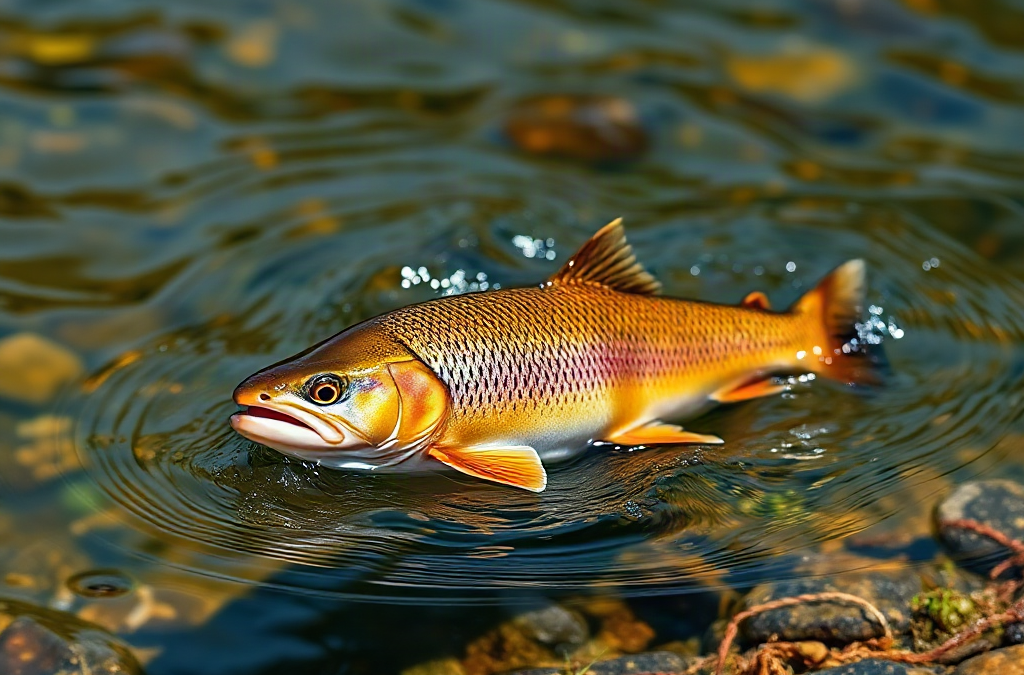
Recognize fish activity in rivers by comparing surface movement, current seams, bait behavior, bird activity, and short-lived disturbances against the river’s normal flow. Repeated dimples, swirls, wakes, or splashes near eddies and current edges often reveal feeding, while nervous minnows or insects disappearing abruptly may indicate predators below. Subsurface clues matter too: soft flashes, moving shadows, and drifting debris that suddenly changes direction can expose fish holding near structure. Watch one area for several minutes before casting, because wind, rising bubbles, and turbulent water can imitate genuine activity.
What you’ll learn
This guide covers the following practical points:
- Read Surface Disturbances Without Chasing False Signals — Surface disturbances become useful only when they differ from the surrounding water in shape, timing, or repetition.
- Find Activity Through Current, Depth, and Structure — River fish often reveal themselves through where movement occurs rather than through an obvious body or fin.
- Use Bait, Insects, and Wildlife as Supporting Evidence — Prey behavior can expose feeding activity before the fish themselves become visible.
- Confirm Activity With a Deliberate Observation Routine — A repeatable observation routine converts scattered clues into a practical casting decision.
Read Surface Disturbances Without Chasing False Signals
Surface disturbances become useful only when they differ from the surrounding water in shape, timing, or repetition. A river already contains boils, bubbles, foam lines, and broken reflections created by current. The task is to separate those constant hydraulic effects from movement produced by a fish turning, feeding, or pursuing prey. Spend a minute watching the general flow before assigning meaning to an isolated splash.
A feeding rise often forms a compact ring, dimple, swirl, or brief bulge that appears independently of the current’s regular texture. Trout taking insects may leave small rings along a slow seam, while a larger predator attacking minnows can create a sharp splash, scattering spray, or a V-shaped wake. Bottom-feeding fish sometimes roll or expose a fin without striking at the surface. The species may not be identifiable from the disturbance alone, but its location and pattern can show whether the movement deserves a cast.
Repetition increases confidence. Three dimples appearing along the same current lane are stronger evidence than one unexplained ring. A wake that pushes upstream or crosses the flow is also more likely to come from an animal because wind and current-driven debris generally travel with dominant forces. Watch where the disturbance begins and where it ends. A swirl tight to a submerged log, undercut bank, bridge shadow, or eddy edge is more meaningful than a random boil in featureless whitewater.
Several common effects imitate active fish. Gas escaping from soft bottom can release bubbles at regular intervals. Turtles, muskrats, diving birds, and frogs create wakes or splashes. Wind produces overlapping ripples, while current rolling over a shallow rock creates a stationary boil that seems to pulse. A stationary disturbance is usually caused by structure; a feeding fish tends to appear intermittently, change position, or interact with prey.

Low light improves visibility in some ways and reduces it in others. Glare may fade near dawn or dusk, making rings easier to see, but shadows become difficult to interpret. Polarized glasses help reveal movement beneath reflected light during brighter periods. Position yourself so the sun is behind or to one side of you, then scan calm pockets beside faster water. For anglers studying how to recognize signs of fish activity in rivers, the priority is not spotting the largest splash; it is recognizing a repeatable disturbance connected to a productive location.
Find Activity Through Current, Depth, and Structure
River fish often reveal themselves through where movement occurs rather than through an obvious body or fin. Flow concentrates food while forcing fish to manage energy, so active individuals commonly hold where they can intercept prey without remaining in the strongest current. Current seams, eddy boundaries, pool heads, pool tails, and protected pockets behind boulders deserve close observation even when the surface appears quiet.
A current seam is the visible boundary between water moving at different speeds. Foam, leaves, or bubbles may collect along it, marking a conveyor belt for insects and small prey. Fish can sit in slower water beside the seam and move briefly into faster flow to feed. Look for pale flashes, shadows sliding sideways, or disturbances that begin on the slow side and touch the faster lane. A fish making repeated short feeding movements may be active even if it never breaks the surface.
Structure changes both current and visibility. A boulder creates a pressure cushion in front, softer pockets along its sides, and a wake behind it. A fallen tree offers shade and flow protection but also snags. An undercut bank can conceal fish in water that looks too shallow from above. Rather than casting directly at visible wood immediately, inspect the upstream edge, outside edge, and downstream pocket. Activity may occur just beyond the obvious cover where drifting food remains accessible.
Depth affects which clues are available. In clear, shallow water, moving shadows and flashes can expose fish, but refraction makes objects appear shallower than they are. In deep or stained water, surface clues, bait reactions, and location become more reliable than direct sight. Mud clouds can indicate bottom-feeding fish, yet current may carry sediment away from the source. Trace the cloud upstream before assuming fish are directly beneath it.
Do not equate dramatic current with productive current. The center of a fast chute may transport abundant food but demand too much energy from fish. Nearby cushions and transition zones are often more practical holding areas. Conversely, completely slack water may offer shelter but deliver little food unless it is connected to a seam or backflow. The strongest reading combines cover, manageable velocity, suitable depth, and access to drifting prey.
A useful test is to identify the apparent holding water before looking for fish. Choose a seam, pocket, or pool transition and observe it for several minutes. If flashes, rises, nervous bait, or repeated swirls appear in the predicted lane, the river’s structure supports your interpretation. If nothing develops, adjust your angle to reduce glare or move to the next current feature rather than assuming the entire reach is inactive.
Use Bait, Insects, and Wildlife as Supporting Evidence
Prey behavior can expose feeding activity before the fish themselves become visible. Small minnows normally hold in schools, face into gentle flow, or move in coordinated bursts. When they scatter abruptly, leap from the water, crowd against the bank, or repeatedly flee the same pocket, a predator may be pressing them from below. A single jump proves little; recurring panic at one edge of a pool is much stronger evidence.
Watch the direction of escape. Minnows spraying outward from one point suggest a fast attack, while a school shifting steadily away from cover may be responding to a cruising fish. Bait pushed into a shallow margin can attract predators even when the main channel looks more impressive. If the prey settles immediately and no attack follows, the disturbance might have been caused by your shadow, a bird, or a rock entering the water. Approach quietly and remain far enough back to avoid creating the behavior you are trying to interpret.
Insect activity offers another layer of evidence, particularly where fish feed on aquatic insects. Flying insects over the surface do not automatically mean fish are feeding. Look for insects drifting in a defined current lane and rises occurring in that same lane. Tiny dimples may indicate fish taking insects just below the film, while more forceful rises can signal larger prey or aggressive feeding. If insects are abundant but rises are absent, fish may be feeding deeper, inactive, or concentrated somewhere else.
Birds can help locate prey, but they require careful interpretation. Swallows working above a riffle point to airborne insects, not necessarily catchable fish. Herons standing beside a shallow edge suggest the area can hold small fish, though a motionless bird does not prove current feeding activity. Diving birds repeatedly entering a confined section provide stronger evidence of bait below, but they may also disrupt the area. Bird location should direct observation, not replace it.

Foam lines and drifting material can reveal where food is being collected. Natural debris converging into a narrow lane shows how the current concentrates objects. Fish may station beneath that lane even without visible surface feeding. Notice any debris that jerks, stops, or moves against the expected flow; it may have contacted structure or, occasionally, a fish. Do not mistake every interrupted leaf for a strike, especially in branches or turbulent pockets.
The best interpretation combines independent clues. Nervous minnows beside a current seam, followed by two swirls and a diving bird upstream, form a persuasive activity pattern. One circling bird over featureless water does not. This evidence-based approach to how to recognize signs of fish activity in rivers prevents anglers from spending too long on attractive but unsupported signs.
Confirm Activity With a Deliberate Observation Routine
A repeatable observation routine converts scattered clues into a practical casting decision. Begin before reaching the water’s edge. Elevated banks, bridges where access is permitted, and stable gravel bars can provide a wider view, but avoid skylining yourself or sending a shadow over shallow holding water. Scan near water first, then work toward distant seams and cover. Fish close to the bank are often disturbed when anglers immediately step into the river.
Use a short sequence that tests each clue rather than reacting impulsively:
- Establish the baseline: watch the current, wind ripples, bubbles, and debris long enough to recognize their normal direction and rhythm.
- Mark likely holding areas: identify seams, eddies, shade, depth changes, boulders, wood, and bank cover.
- Look for repetition: count rises, flashes, bait reactions, or wakes and note whether they recur in one lane.
- Change the viewing angle: move carefully to reduce glare and verify that a shadow or flash is not a rock or reflection.
- Test with one controlled presentation: cast beyond the suspected fish and bring the bait or fly naturally through its feeding path.
The first cast should test the interpretation, not simply land on the visible disturbance. Casting directly onto a rise can spook the fish or place the offering behind its feeding position. If a fish rises repeatedly in a seam, present upstream so the current carries the offering into the same lane. For a predator chasing minnows along a bank, cast beyond the activity and retrieve through its edge rather than through the center of the bait school.
Success is not limited to a hooked fish. A follow, missed strike, bait school reaction, or fish shifting from cover confirms that the area is occupied. Failure also provides information. If repeated natural-looking presentations produce no response, the disturbance may be non-fish activity, the fish may be feeding on a different prey size, or your angle may be crossing the lane unnaturally. Change one variable at a time—depth, speed, profile, or casting angle—so the response remains interpretable.
Conditions can erase or distort visual signs. Wind makes subtle rises difficult to distinguish, stained water hides flashes, and high flow expands current seams or moves fish toward protected margins. Under those constraints, prioritize location and prey behavior over direct sight. In clear, calm water, visual confirmation becomes more useful, but fish may also detect careless movement more easily. Observation distance and stealth matter more as visibility improves.
Keep a simple mental record of where signs appeared relative to flow, cover, light, and water level. A productive seam may shift when discharge changes, while shade lines move through the day. The aim is not to memorize one visible splash but to connect activity with the physical reason fish used that location. That connection lets you identify similar water farther upstream or on another river.
Frequently Asked Questions
Do bubbles on a river mean fish are feeding?
Not by themselves. Stationary or regularly rising bubbles may come from decomposing material, disturbed sediment, or turbulence. Bubbles paired with moving swirls, mud clouds, or repeated surface feeding are more useful.
What does a fish feeding on the surface look like?
It may create a small dimple, expanding ring, bulge, swirl, splash, or briefly exposed fin. The exact form depends on the species, prey, and feeding speed, so repetition in one current lane matters more than splash size.
Are jumping fish always actively feeding?
No. Fish may jump while escaping predators, dislodging irritation, moving through shallow water, or reacting to disturbance. Look for nearby prey, repeated pursuit, and continued activity before treating jumps as feeding evidence.
Where should I look first in a river?
Start with current seams, eddy edges, shaded banks, pool heads and tails, and protected pockets beside boulders or wood. These places combine food delivery with relief from strong flow.
How long should I watch before casting?
Several quiet minutes are often enough to establish the normal surface pattern and detect repeated rises or bait reactions. Extend the observation when glare, wind, deep water, or complex currents make the clues ambiguous.
Conclusion
Reliable river reading comes from connecting movement to current, cover, depth, and prey rather than chasing every splash. Establish what the water does naturally, then look for disturbances that repeat, travel independently of the flow, or occur beside a likely feeding lane. Give added weight to clues that agree with one another, such as scattering minnows, a swirl along a seam, and a fish-shaped flash beneath the surface.
Before casting, change your viewing angle, reduce glare, and identify where the fish would hold relative to the visible activity. Make a controlled presentation through that lane and use follows, strikes, or bait reactions to test your reading. If the evidence remains weak, move to another defined feature. Careful observation preserves stealth, reduces unproductive casting, and gradually turns subtle river signals into dependable location decisions.

