
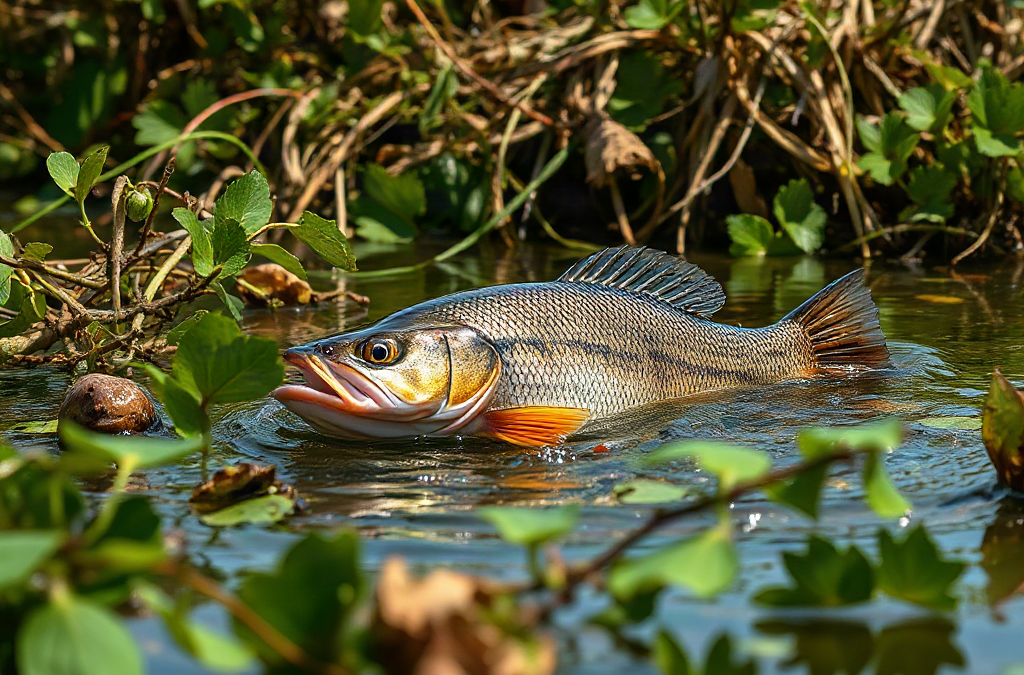
Strategies for fishing in heavily vegetated areas work best when lure selection, boat position, and hooksets are planned around the cover rather than treated separately. Use weedless soft plastics, frogs, or compact jigs to reduce snags; cast beyond openings and retrieve along edges where fish can ambush prey; then keep the rod high and apply steady pressure to move a hooked fish away from stems. Dense vegetation can hide productive shade, oxygenated water, and forage, but it also limits casting angles and gives fish leverage. Change lure weight, line strength, and presentation speed when vegetation becomes thicker or fouler than expected.
Read Vegetation as Fish Habitat
Heavily vegetated water is rarely uniform, and treating an entire weed bed as equally productive wastes casts. Identify the edges, pockets, points, lanes, and changes in plant density first. Fish often use these irregularities because they provide concealment while leaving enough open water for feeding and movement. A clean hole inside a mat, a channel through emergent stems, or a sharp outside edge can be more valuable than the thickest vegetation nearby.

Plant type also changes the fishing problem. Submerged grass may allow a bait to slide across the canopy, while milfoil, hydrilla, or coontail can grab exposed hooks and collect soft debris. Lily pads create shade and overhead cover, but the open water between pads may offer a better lane for a moving lure. Reeds and cattails are often less forgiving because stems restrict both the retrieve and the angle available for landing a fish.
Begin by looking for combinations rather than isolated features. Vegetation beside a drop-off, a creek channel, a hard bottom, or a current seam can concentrate fish more reliably than a broad flat with no depth or structural change. Wind may push plankton and small prey toward one side of a weed line, while bright conditions can make the shaded side of a mat more attractive. These are useful clues, not guarantees; fish may relocate when water level, temperature, or forage movement changes.
A common mistake is fishing only the visible outside edge. Work the first cast parallel to that edge, then test the pockets and interior lanes before moving on. If several casts come back clean but produce no signs of activity, do not assume the cover is empty. Slow down, change the depth of the presentation, and inspect a nearby irregularity. The goal is to find the part of the vegetation that offers fish both security and an efficient feeding position.
For more location-focused planning, connect these observations with broader strategies for fishing in heavily vegetated areas instead of relying on a single lure or favorite shoreline.
Choose Lures, Line, and Tackle for Cover
Weedless lures are the foundation of fishing dense vegetation because they let the presentation reach places that open-hook baits cannot. Texas-rigged soft plastics, hollow-body frogs, weedless swimbaits, and compact jigs each solve a different access problem. A soft plastic can probe holes and edges slowly, a frog can cross floating vegetation, and a jig can fall through a canopy or imitate a compact prey item near the bottom.
Match the lure to the surface and the amount of obstruction. A frog is useful when fish can look upward through pads or mats, but it is a poor choice when the vegetation is mostly submerged and the lure cannot create a visible target. A lightly weighted worm may glide over sparse grass, while a heavier pegged rig is more practical when the bait must punch through a thick canopy. The heavier option reaches fish sooner but can disturb the cover and may fall too quickly in thinner growth.
Line choice is a tradeoff between abrasion resistance, manageability, and lure action. Braided line is commonly favored around dense grass because it cuts vegetation better than many softer lines and transmits contact with the lure. A fluorocarbon leader may be useful in clearer water or around sparse cover, but knots and leader length add another potential failure point. In especially abrasive cover, simplicity and strength may matter more than a low-visibility leader.
Rod power and reel performance matter once a fish is hooked. A rod with enough backbone can turn a fish before it buries itself, while a smooth drag and a reel with adequate line capacity reduce sudden breakoffs. Do not select tackle solely by the size of the lure. A small bait fished around thick stems can create more extraction pressure than a larger lure worked along a clean edge.
Before casting, inspect the hook point, check that the plastic is aligned, and remove any vegetation after every productive-looking retrieve. A bait that rides cleanly for only the first few feet is not presenting properly. The most frequent rigging failure is leaving the hook point too exposed for dense cover or burying it so deeply that the hookset cannot penetrate. Test the rig beside the boat and correct its posture before making a long cast.
Control Casting Angles and Boat Position
Boat position determines whether a lure moves naturally through vegetation and whether a hooked fish has a clear path to safety. Position outside the target zone when possible, then cast past the feature and retrieve across it. Casting directly into a pocket can work, but a longer approach often gives fish more time to see the lure and keeps the boat from pushing water into a shallow ambush area.
Parallel casts are especially effective along a weed edge because they keep the lure in the strike zone longer. Perpendicular casts, by contrast, may cross the edge quickly but can reveal whether fish are holding inside or outside the line. A third angle—diagonal across a point or lane—can expose a different side of stems and often reaches fish that ignore repeated casts from one direction.
Quiet positioning matters in shallow vegetation. Use the trolling motor conservatively, avoid repeatedly bumping the hull, and plan a drift before making a series of casts. Wind can be useful for moving along a broad edge, but it may push the boat into fragile cover or make precise frog work difficult. Anchoring may improve accuracy in a small pocket, although it limits the ability to follow a fish and can disturb the bottom when repositioned.
Consider what happens after the strike, not just where the lure lands. If a fish will immediately reach a thick mat, stand of reeds, or submerged timber, choose a casting angle that creates a more direct extraction route. For example, a cast from the open-water side of a pad field may offer better leverage than a cast from inside the pads. The best angle is often the one that gives both the lure and the hooked fish room to travel.
Weak assumptions cause many missed opportunities. Seeing a broad weed line does not mean the entire line deserves equal attention, and a quiet surface does not prove that topwater presentations are ineffective. Mark productive pockets mentally or electronically where lawful, rotate through nearby angles, and leave unproductive stretches rather than repeatedly dragging a fouled lure through identical water. A precise cast to a small opening usually beats a long cast that lands randomly across the bed.
Set the Hook and Extract Fish Safely
Hooksets around heavy vegetation must move the hook into the fish and the fish away from the cover. With a Texas-rigged plastic or jig, reel down until the line is connected, then drive the hook firmly with the rod moving toward open water. A delayed, sweeping hookset may allow the fish to turn deeper into the vegetation, while an uncontrolled overhead swing can pull the lure away before the hook penetrates.
Frog fishing requires a different rhythm because hollow bodies often collapse before the hooks can catch. Wait until the fish has taken the frog and the line begins moving, then lower the rod, reel until pressure is present, and set decisively. The correct delay varies with the strike and distance, so watching the line is more useful than following a fixed count. Setting instantly at every surface explosion is a common reason for empty strikes.
Once connected, keep the rod high enough to lift the fish’s head and use steady pressure rather than repeated violent pumps. If the fish enters grass, maintain tension and pull the mass toward the boat while avoiding slack. A landing net may be difficult to use in a dense mat, so plan whether the fish can be hand-landed safely and whether the vegetation should be cleared before the next cast. Gloves can protect hands from rough stems, hooks, and sharp edges, but they do not replace careful fish handling.

Heavy line and powerful tackle reduce breakoffs, yet they do not make every extraction safe. Excessive drag pressure can straighten hooks, damage knots, or tear a fish’s mouth. Conversely, a loose drag gives a strong fish time to wrap the line around stems. Set the drag before casting and test the knot with controlled pressure. If the line repeatedly fails at the same point, inspect for abrasion instead of simply increasing tackle strength.
Land the fish quickly when it is buried in vegetation, support its weight horizontally when practical, and return it to the water without unnecessary delay. The objective is controlled separation from the cover, not a prolonged contest. These practical details complement other strategies for fishing in heavily vegetated areas by protecting both the catch and the equipment.
Adjust Presentations When the Cover Changes
Vegetation changes throughout the day, the season, and the water cycle, so a presentation that worked at first light may fail after the surface warms or wind shifts. Start with the most accessible high-percentage feature, then adjust based on what the lure tells you. Clean contact with the top of the grass, repeated short strikes, or fish following without committing each points toward a different adjustment.
Use a faster retrieve when fish are active or when the lure must stay above snag-prone stems. Slow down when the cover has isolated holes, when the water is cool, or when fish are holding tightly to shade. If the bait constantly gathers vegetation, reduce exposed hardware, change the retrieve angle, or choose a lure designed to move through the specific plant type. More casting effort does not correct a presentation that is fouling every few seconds.
A compact decision sequence keeps experimentation controlled:
- First: fish the cleanest edge or opening with a weedless moving presentation.
- Next: slow down with a soft plastic or jig if fish appear to be holding tightly to cover.
- Then: change entry depth or angle before abandoning the area.
- Finally: move to a different vegetation feature if the lure remains clean but the location shows no signs of life.
For example, a calm morning over lily pads may favor a surface frog, while a bright, breezy afternoon may make the shaded outside edge more productive with a submerged bait. Neither choice is universally better. Surface lures provide exciting strikes but can miss fish that are feeding below the canopy; subsurface lures reach more depth but may collect grass and lose visibility.
Keep notes on plant type, depth, cloud cover, retrieve speed, and the exact feature that produced activity. Over time, those observations reveal whether fish in a particular lake prefer isolated holes, outside edges, or lanes near deeper water. Avoid changing several variables after every cast, because you will not know which adjustment caused a response. A disciplined change in lure, angle, or speed produces more useful information than random switching.
For lake-specific plant identification, access rules, and local habitat information, consult your state wildlife agency, fisheries department, or university extension service. Those sources can clarify which vegetation is present and whether local regulations affect access, harvest, or the use of boats and anchors.
Frequently Asked Questions
What is the best lure for fishing in thick weeds?
There is no single best lure. Weedless soft plastics and compact jigs are versatile for submerged cover, while hollow-body frogs are useful across floating vegetation and mats.
Should I fish the edge or the middle of a weed bed?
Fish both, but begin with irregular edges, points, pockets, and lanes. The middle becomes more worthwhile when it contains openings, shade, or a clear route through the vegetation.
How do I stop my lure from collecting weeds?
Use a properly aligned weedless rig, match lure weight to plant density, and change the retrieve angle or speed. Remove vegetation after each cast and inspect the hook point.
What line works well around heavy vegetation?
Braided line is often practical because it resists abrasion and cuts through grass. A leader can suit clearer water, but knot quality and cover density should guide the decision.
How should I set the hook in heavy cover?
Reel down until the line is tight, then drive the hook firmly while directing the rod toward open water. With frogs, wait until the fish has taken the lure and the line moves before setting.
Further Reading
Authoritative Sources
- Academy of Nutrition and Dietetics
eatright.orgProfessional nutrition guidance, healthy eating resources, and practical dietitian-reviewed advice.
- U.S. Department of Agriculture
usda.govOfficial food, nutrition, agriculture, and consumer guidance from the USDA.
- NIH Office of Dietary Supplements
ods.od.nih.govResearch-based fact sheets on nutrients, supplements, dietary intake, and safety considerations.
- International Society of Sports Nutrition
sportsnutritionsociety.orgEvidence-informed sports nutrition resources and position stands for active people and athletes.
Conclusion
Successful fishing in dense vegetation comes from treating cover as a three-dimensional habitat rather than an obstacle. Prioritize irregular edges, pockets, shade, depth changes, and lanes that give fish both concealment and access to prey. Use a lure that stays clean, rig it carefully, and select line and tackle for the pressure required after the strike. Boat position deserves equal attention because a good cast can still fail if the extraction route leads directly into the thickest cover. Change one variable at a time when the presentation fouls or fish only follow. With consistent observation, controlled hooksets, and realistic tackle choices, heavily vegetated water becomes easier to interpret and far more manageable to fish.

