
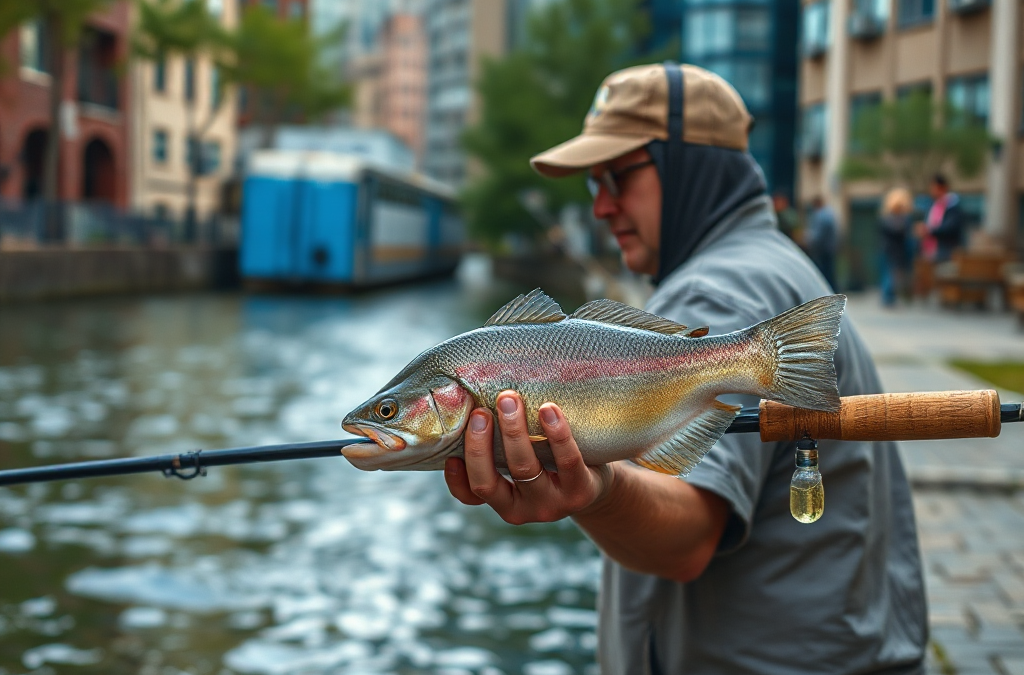
How to fish effectively in urban settings means selecting legal, accessible water, reading man-made cover, and adjusting tackle for short casts, pressured fish, and changing water quality. Check local access rules and consumption advisories before fishing, then focus on current seams, shaded edges, drains, bridge supports, and other places that concentrate food. Use compact tackle, quiet presentations, and lures or bait suited to the species already present rather than relying on a single urban pattern. Move when several careful casts produce no signs of activity, and treat litter, unstable banks, traffic, and contaminated water as reasons to leave—not obstacles to ignore.
Find Legal, Productive Water in the City
Urban fishing improves when location selection comes before lure selection. A small pond, canal, riverwalk, stormwater lake, or reservoir arm can hold fish, but access rules, bank stability, water quality, and nearby human activity determine whether it is a sensible place to fish. Check the relevant state or provincial agency for a license, species rules, seasonal closures, hook restrictions, and consumption advisories. Property boundaries and posted signs matter just as much as the presence of fish.

Public access does not automatically mean every shoreline is safe or fishable. A paved bank with room for casting may be more useful than a secluded drainage channel with steep sides and no clear exit. Look for maintained paths, visible water, stable footing, and enough space to cast without placing pedestrians or cyclists at risk. Early reconnaissance from a bridge, public trail, or map can reveal access points without trespassing.
Productive urban water usually has a reason for concentrating food or providing shelter. Inlets can deliver oxygen and insects, while outflows create current that moves small prey. Park ponds may collect leaves, insects, and runoff-fed nutrients near their edges. A feature that looks attractive but has no depth change, cover, current, or visible forage may deserve less time than an ordinary-looking corner.
A useful first-visit filter is simple:
- Confirm legal access and any local restrictions.
- Identify a safe route in and out before carrying tackle to the bank.
- Look for current, shade, vegetation, depth changes, and bait activity.
- Choose a position that permits several casting angles without crowding others.
The common mistake is treating urban water as interchangeable. A shallow decorative pond, tidal river, and concrete-lined canal require different expectations. Keep notes on water level, weather, visible forage, successful areas, and productive times. That record turns scattered city spots into a usable pattern. For broader advice on how to fish effectively in urban settings, location quality remains the first decision to improve.
Read Concrete, Current, and Urban Cover
Man-made structure changes how fish travel, feed, and avoid danger. Bridge pilings, retaining walls, dock edges, culvert mouths, riprap, submerged pipes, and abrupt transitions between mud and concrete can create shade, ambush points, or breaks in current. Fish do not occupy every piece of structure equally; the valuable part is usually where cover intersects food movement, depth, or a current seam.
At a canal, inspect the boundary where slow water meets faster flow. Bait may struggle in that seam, while predators can hold just outside the strongest current and spend less energy waiting for food. Around a bridge, the upstream face may collect drifting material, but the downstream eddy can offer calmer water. In a pond, a shaded wall or patch of submerged vegetation may be more useful during bright conditions than an exposed center.
Surface appearance can mislead. A clean concrete edge may hide a narrow ledge, while a broad shallow flat may look promising but contain little cover. Watch for swirls, nervous bait, birds feeding, insects falling from overhanging trees, and slight color changes that indicate depth or bottom composition. Make a few exploratory casts at different angles instead of repeatedly throwing to the most obvious object.
Start with the least disruptive presentation. Cast parallel to a wall or bank when fish are likely to patrol the edge; cast across a current seam when drifting food is the stronger clue. A small soft plastic, compact jig, inline spinner, or live bait under a float can cover different depths without requiring a long cast. The best choice depends on local species, water clarity, regulations, and what fish are already eating.
A frequent failure is casting directly onto cover every time. That can snag the lure, spook fish in clear shallows, and leave the water around the feature unexplored. Try the edge first, then the up-current side, shadow line, and deeper face. If fish follow but do not strike, slow the retrieve or reduce lure size; if nothing responds after covering several angles, the feature may be inactive at that moment.
Match Tackle and Presentations to Tight Quarters
Urban banks reward portable tackle that controls a lure accurately rather than equipment designed for maximum distance. A light or medium-light spinning setup is practical for many panfish and smaller predators, while a medium setup gives more control around weeds, rocks, or larger species. The correct line strength depends on the target and cover; ultralight line may improve casting but leaves little margin around sharp concrete or submerged debris.
Compact lures are often easier to work around pedestrians, trees, railings, and narrow casting lanes. Small jigs, soft plastics, spinners, jerkbaits, and bait rigs can probe different depths, but each has a cost. Treble-hooked lures may catch well yet snag frequently near riprap and discarded material. Weedless hooks reduce hang-ups in vegetation but may require a firmer hook-set. Live bait can be effective but may be restricted, inconvenient to transport, or inappropriate where bait release is prohibited.
Presentation should match the available water rather than imitate open-lake casting. A short, accurate pitch beside a wall may outperform a long cast that lands in the middle of inactive water. Let a jig fall beside a piling, retrieve a spinner through a current seam, or keep a soft plastic close to bottom along a drop. Pause length matters: pressured fish may inspect a lure during the pause, while active fish may respond better to a steady moving target.
Use a compact decision sequence before changing everything:
- Cover the upper and middle water with a moving lure.
- Probe the bottom or edge with a slower bait or jig.
- Change angle before changing lure size repeatedly.
- Downsize when fish follow, short-strike, or show in clear water.
- Move when the spot offers no activity after several depths and angles.
The wrong assumption is that lighter tackle always makes urban fishing better. Light gear is pleasant and discreet, but a heavier leader may be the wiser tradeoff beside barnacled walls, mussels, broken glass, or dense brush. Inspect the final section of line after every snag or rough contact. A frayed leader can fail on the next fish even when the knot and reel appear fine. Practical how to fish effectively in urban settings depends on control, not on carrying the largest selection of lures.
Manage Safety, Water Quality, and Fishing Pressure
Urban fishing combines angling risks with hazards that are less common on a remote shoreline. Traffic, unstable retaining walls, slippery algae, exposed electrical infrastructure, aggressive wildlife, broken containers, and sudden water releases can all change a routine outing. Wear shoes with dependable grip, keep hooks secured when walking, and avoid climbing barriers or standing close to fast water simply to reach a promising cast.
Water quality deserves separate attention from fishability. Urban runoff can carry oil, chemicals, litter, and other pollutants, especially after heavy rain. Local advisories may limit or prohibit eating certain species even when catch-and-release fishing is allowed. Wash hands after handling fish, keep food and drinks away from bait and tackle, and follow local guidance about cleaning or releasing catches. Never assume clear water is safe to consume from or that a familiar park pond has the same standards as a monitored public lake.
Human pressure also changes fish behavior. A heavily visited shoreline may produce fish at dawn, late evening, or during poor weather when fewer people are present, but low light creates its own visibility and personal-safety concerns. Quieter presentations, longer pauses, and casts that stay close to cover can be useful when fish have seen constant traffic. Conversely, a busy area may continually introduce crumbs, insects, and disturbance, making it unexpectedly productive at certain times.

Respect for other users is part of effective urban angling. Leave room around walkers, ask before occupying a shared access point, and never cast across a path or near swimmers. Pack out line, hooks, bait containers, and every piece of litter you bring. A spot that becomes unsafe or socially disruptive is not a successful spot, regardless of how many fish it might hold.
Stop fishing when footing deteriorates, water rises, lightning approaches, visibility drops, or nearby activity makes casting unsafe. The common mistake is interpreting a dangerous position as evidence of a better fishing opportunity. Fish can often be reached from a safer angle, at a different water level, or from another public access point. If not, leaving is the correct decision.
Build a Repeatable Urban Fishing Plan
A repeatable plan prevents short city sessions from becoming random lure changes. Before leaving, choose one target species or size range, identify two or three legal access points, and pack only the tackle needed for likely conditions. Include pliers, spare leaders, a landing method suited to the bank, hand cleaning supplies, and a way to carry used line and small waste. A compact kit makes it easier to relocate when a crowded or unproductive area fails.
Give each spot a structured trial. Spend the first few minutes observing rather than immediately casting: note wind, water level, current, shade, bait, and activity. Fish the nearest high-percentage feature with a moving presentation, then change depth or angle. If the water provides no signs after a disciplined rotation, relocate. This is more productive than staying for an hour because a location looked promising on a map.
Record evidence, not just success. Write down the exact bank feature, retrieve speed, lure profile, water clarity, time, and whether the fish struck near cover or in open water. A blank trip still provides useful information if it eliminates a tide stage, weather pattern, or unproductive section. Over several visits, the notes may show that a particular inlet works only after water movement begins or that a shaded wall holds fish during bright afternoons.
Beginner anglers often change bait before checking positioning. Experienced urban anglers usually improve the cast angle, retrieve depth, or distance from cover first because those changes test a specific hypothesis. A lure change makes sense when fish reject the profile, feeding behavior changes, or the current demands a different weight. This distinction saves time and keeps observations interpretable.
Use how to fish effectively in urban settings as a process of testing safe, legal, fishable water—not as a promise that every city shoreline will produce. Prioritize access, observation, controlled presentations, and timely movement. Those choices produce clearer feedback and make even a short after-work session more worthwhile.
For current license requirements, access rules, species regulations, and consumption advisories, consult the official fish-and-wildlife agency for the location you plan to visit. Municipal parks and water authorities may provide additional information about shoreline access, closures, and water-safety notices.
Frequently Asked Questions
Is urban fishing safe after heavy rain?
Conditions depend on the waterway. Runoff can increase current, debris, slippery footing, and contamination concerns, so wait for safer water and check local advisories before fishing or eating a catch.
What lure works well around city bridges and walls?
A compact jig, soft plastic, spinner, or species-appropriate bait can work. Fish the edge, shadow, and current seam first, selecting a snag-resistant option when concrete or debris is present.
How long should I stay at one urban fishing spot?
Give the area a disciplined test across several angles and depths. Move when there are no signs of bait, follows, bites, or suitable holding water after that rotation.
Do I need different line for urban waterways?
Often, yes. Abrasion from concrete, riprap, metal, and debris may justify a stronger leader than open-water conditions, even when light main line is useful for casting.
Can I keep fish caught in a city pond?
Only if local regulations and health advisories allow it. Check the authority responsible for that water before keeping fish, and follow its limits, cleaning guidance, and species-specific warnings.
Further Reading
Authoritative Sources
- Academy of Nutrition and Dietetics
eatright.orgProfessional nutrition guidance, healthy eating resources, and practical dietitian-reviewed advice.
- U.S. Department of Agriculture
usda.govOfficial food, nutrition, agriculture, and consumer guidance from the USDA.
- NIH Office of Dietary Supplements
ods.od.nih.govResearch-based fact sheets on nutrients, supplements, dietary intake, and safety considerations.
- International Society of Sports Nutrition
sportsnutritionsociety.orgEvidence-informed sports nutrition resources and position stands for active people and athletes.
Conclusion
Effective urban angling comes from making better decisions before and during each cast. Verify access and local advisories, choose stable ground, then look for the intersection of cover, current, shade, depth, and forage. Compact tackle and accurate presentations usually outperform an overloaded bag of lures, but line strength and landing control must suit abrasive city structure. Treat each visit as a short experiment: observe first, test a feature at more than one depth, document what happens, and move when the evidence is weak. Never trade personal safety, public access, or water-quality precautions for a speculative bite. With that discipline, canals, ponds, rivers, and reservoirs within or near a city become more understandable and easier to fish responsibly.

