
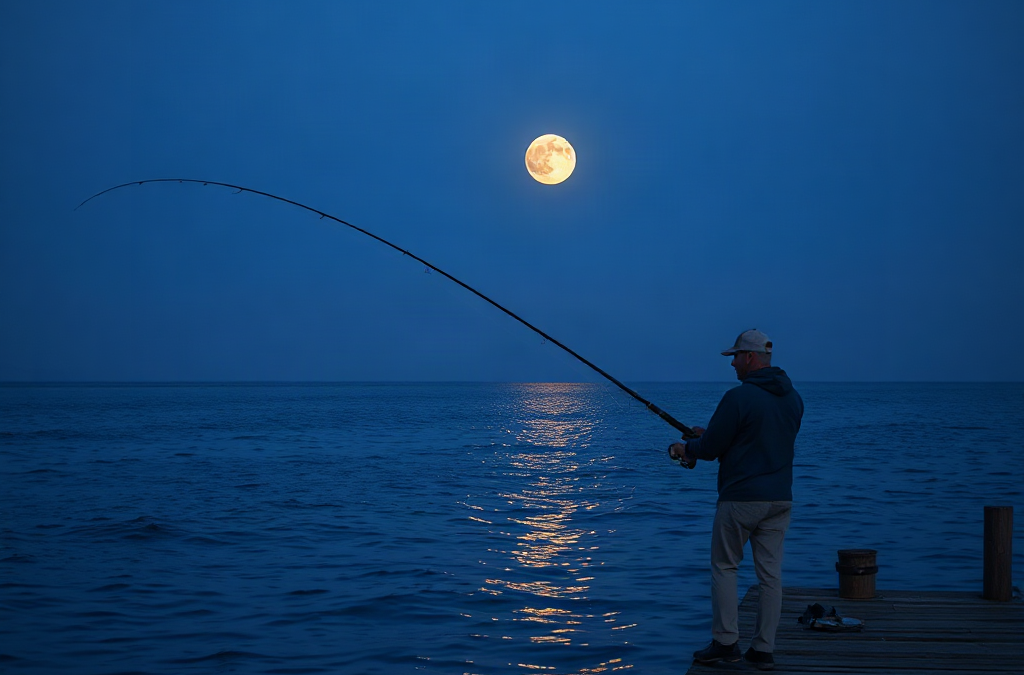
To fish effectively during different moon phases, use the moon as a planning signal rather than a guarantee: adjust fishing time, depth, lure visibility, and location according to nighttime illumination and any moon-driven tides. Full moons can extend feeding after dark, sometimes weakening the dawn bite, while new moons may concentrate activity around low-light periods. In coastal water, prioritize tide movement because lunar gravity affects current and bait movement more directly than moonlight does. Keep notes on catch time, cloud cover, water temperature, tide stage, and baitfish activity so local evidence—not a generic lunar calendar—determines your next trip.
What Moon Phases Actually Change
Moon phase can influence a fishing trip through two different mechanisms: nighttime illumination and tidal force. Those effects should not be treated as interchangeable. Moonlight can alter when predators and prey feel comfortable moving in shallow or open water, while lunar gravity contributes to tidal range and current in oceans, estuaries, and tidal rivers. Inland lakes without meaningful tides are affected mainly by available light, although local fish behavior may not follow a consistent lunar pattern.

A full moon rises near sunset and provides substantial nighttime light when skies are clear. Predatory fish may use that visibility to hunt after dark, especially where baitfish move along shallow flats, weed edges, or open banks. If fish have fed through the night, the familiar sunrise window may be shorter or less productive the next morning. A new moon produces a darker night, potentially making dawn, dusk, artificial light, or periods of heavy prey movement more influential. Cloud cover can erase much of this difference; an overcast full-moon night may be darker than a clear night during a brighter transitional phase.
Saltwater anglers should give tide stage more weight than the phase name printed on a calendar. New and full moons tend to coincide with larger differences between high and low water, often producing stronger currents. First- and third-quarter moons are generally associated with smaller tidal ranges. The exact height, direction, and timing vary by location, shoreline shape, wind, and weather, so an official local tide prediction is more useful than a universal claim that a particular phase produces the best bite.
For example, a strong outgoing tide may pull shrimp or small baitfish from marsh drains into a channel where predators can intercept them. The productive feature is not simply the full moon; it is concentrated forage moving through a predictable route. Conversely, exceptionally fast current can make a normally good point difficult to fish. Fish may shift into an eddy, behind a bridge piling, or along the protected side of structure rather than holding in the strongest flow.
The common mistake is assigning every good or poor catch to the moon. Water temperature, dissolved oxygen, wind direction, barometric changes, seasonal movement, fishing pressure, and available forage can outweigh lunar effects. Treat how to fish effectively during different moon phases as a process of testing timing and location under local conditions, not as a promise that one date will outperform every other date.
New Moon and Full Moon Tactics
New and full moons deserve separate plans because they create opposite lighting conditions even though both can produce stronger tidal movement in coastal environments. Begin by deciding whether moonlight or current is the dominant influence where you fish. A reservoir bass angler may care about overnight visibility, whereas an inshore angler should usually organize the trip around moving water and then refine the plan using light, wind, and clarity.
Fishing Around a New Moon
Dark new-moon nights can reduce the distance at which fish locate prey visually. In clear freshwater, that may concentrate useful opportunities around sunset, sunrise, shoreline lights, or areas where prey can be detected through vibration and sound. Lures with a distinct silhouette, steady vibration, or water displacement can be easier for predators to track than small, translucent presentations. A dark spinnerbait, vibrating jig, wake bait, or slow-moving soft plastic may be practical in shallow cover, but lure choice should still match the species and forage.
Darkness does not automatically mean fish will be shallow. Clear water may encourage some species to move closer to shore, while cold water, weak forage activity, or heavy angling pressure can keep them deeper. Start at a route connecting secure water to a feeding area—such as a creek channel beside a flat—rather than assuming every bank will become productive. Strikes, visible bait, and surface disturbance indicate that the shallow plan is working; empty water and repeated passes without forage are reasons to change depth or location.
Fishing Around a Full Moon
A clear full-moon night can support extended feeding after sunset. Night fishing may therefore be more productive than waiting exclusively for the following morning. Target edges where predators can use light to see prey while remaining close to cover: weed lines, dock shadows, points, reef edges, and transitions between clear and stained water are useful examples. Use enough lure contrast to remain visible without assuming that maximum flash is always desirable.
If fishing after sunrise, test deeper shade, steeper breaks, submerged cover, or current seams earlier than usual. Fish that fed overnight may not respond to an aggressive search bait at first light. A slower presentation placed close to a resting area can be a better second option. In coastal water, however, a favorable tide may restart feeding even after a bright night, so do not abandon a location solely because the lunar theory predicts a weak morning.
The main failure is using one fixed rule—new moon for shallow fish or full moon for large catches—across every waterbody. Instead, compare two windows during each phase. Fish part of the night and part of the next dawn, or compare the beginning and middle of a moving tide. That direct comparison reveals whether local fish are responding more strongly to illumination, current, or another condition.
Quarter-Moon and Transitional-Phase Adjustments
Quarter moons and the days between major phases often provide more moderate conditions, which can make fish behavior easier to interpret. Nighttime illumination changes progressively rather than switching abruptly on the named phase date. A waxing moon becomes brighter each evening, while a waning moon grows darker. Moonrise and moonset also shift from day to day, changing when light is actually present during a fishing session.
First-quarter and third-quarter periods generally produce smaller tidal ranges than new and full moons. Reduced current can be useful when spring-tide flow is too strong to present a bait naturally. A kayak angler, for example, may be able to hold position along an inlet edge during moderate flow but struggle safely and effectively during a fast new-moon tide. Fish may also spread across a flat when current is manageable instead of crowding into protected pockets.
The tradeoff is that weaker water movement may transport less forage and provide fewer obvious feeding lanes. When tidal current slows, narrow the search to places where even modest flow is concentrated: channel bends, points, creek mouths, dock pilings, gaps in oyster structure, and depth changes. Use a lighter sinker when possible so a bait drifts naturally. If the rig continually races past the target during stronger flow, increase weight or move to a sheltered seam rather than repeatedly making an uncontrolled presentation.
In freshwater, transitional phases are useful for testing whether moonlight truly matters on a particular lake. Suppose fish bite along a shallow weed edge during several clear evenings as the moon waxes, but stop after cloud cover arrives despite a similar phase. Light is a plausible contributor. If the bite instead tracks water temperature and wind-driven baitfish regardless of visible moonlight, those conditions deserve priority in future planning. A fishing log makes that distinction clearer than memory, which tends to preserve unusually good full-moon trips and forget ordinary ones.

Moon position may also matter more than the label “quarter moon.” A moon below the horizon cannot brighten the water, and a low moon blocked by trees or cliffs may have little immediate lighting effect. Before choosing a nighttime tactic, check moonrise, moonset, expected cloud cover, and the orientation of the shoreline. This is a more precise approach than selecting tackle from the phase alone.
Anglers researching how to fish effectively during different moon phases should use quarter phases as comparison periods, not second-rate dates. Moderate tides, partial light, and lower expectations can create practical advantages, especially where boat control, safe wading, or natural bait presentation becomes difficult during extreme water movement.
A Practical Moon-Phase Fishing Plan
A useful lunar plan connects the phase to observable conditions before assigning a tactic. Start with the waterbody. On non-tidal freshwater, examine light, season, temperature, wind, clarity, cover, and forage. On tidal water, begin with a location-specific tide table and identify when current will move past fish-holding structure. Moon phase then supplies context for how bright the night may be and how large the predicted tidal range could become.
Use this compact sequence before leaving home:
- Check the phase and moon timing. Record illumination, moonrise, moonset, and whether the moon will be above the horizon while fishing.
- Check local conditions. Note cloud cover, wind, recent rain, water temperature, clarity, and—in coastal areas—high and low tide times.
- Select two feeding windows. Compare night with dawn, dusk with early night, or incoming with outgoing current instead of betting the trip on one hour.
- Choose a primary and backup location. Pair an exposed feeding area with nearby deeper water, shade, slack water, or cover.
- Match presentation to visibility and flow. Adjust lure profile, retrieve speed, color contrast, and sinker weight only as conditions justify.
Consider a full-moon trip to a tidal bay. The tide forecast shows strong outgoing water shortly after sunset. Begin near a marsh drain where current funnels bait toward a channel, but keep a protected secondary position nearby. If the lure cannot stay in the strike zone or floating debris makes the drain unfishable, move to the edge of an eddy rather than concluding that the moon prediction failed. Visible bait being swept through the drain, repeated bird activity, or strikes at the current boundary confirm that the location and timing are aligned.
A new-moon lake trip calls for a different test. Fish a shallow point near sunset with a lure that creates a clear vibration, then move along the adjacent drop if surface activity disappears. If bites occur only during the fading-light period, schedule the next trip around that short window. If fish remain active after dark near dock lights, artificial illumination and concentrated prey may be more useful predictors than the lunar phase itself.
Record date, phase, moon visibility, catch time, depth, location, weather, water conditions, lure, and observed forage. Three or four entries are not enough to establish a dependable pattern, but consistent notes gradually separate repeatable local behavior from coincidence. Failure signs include changing lures constantly without changing unproductive water, remaining in unsafe current, or ignoring obvious bait movement because an app identifies a different “major” period.
The best next move is always evidence-based. Stay when bait is present, fish are following, or occasional strikes suggest that presentation needs refinement. Relocate when the water lacks forage, the current cannot be fished effectively, or the selected depth produces no contact. That approach makes lunar planning useful without allowing it to override what is happening on the water.
Frequently Asked Questions
Which moon phase is best for fishing?
No single phase is best everywhere. New and full moons may intensify coastal tides, while moonlight can alter nighttime feeding in clear water. Local tide movement, weather, forage, and season usually deserve equal or greater weight.
Is fishing good on the morning after a full moon?
It can be, but fish that fed under bright moonlight may be less active at dawn. Test deeper shade or cover, and let current, bait activity, and actual strikes determine whether to stay.
Should lure color change with the moon phase?
Change color according to visibility rather than the calendar alone. Dark silhouettes and vibration can help at night, while natural or subtle colors may suit clear, illuminated water when fish inspect a lure closely.
Do moon phases affect freshwater and saltwater fishing equally?
No. Coastal fishing can be affected by moon-driven tides and nighttime light. Most inland freshwater fishing lacks a meaningful tidal component, leaving illumination as the more plausible direct lunar influence.
How should beginners use a lunar fishing calendar?
Use it to choose times worth testing, not to predict guaranteed catches. Compare its suggested periods with local weather, tide information, water temperature, and visible forage, then record what actually happens.
Conclusion
Moon-phase planning works best when it sharpens decisions about timing, current, visibility, and location rather than dictating them. On tidal water, identify fishable current and forage routes first; on inland water, compare nighttime illumination with weather, temperature, and seasonal fish movement. Build each trip around two plausible feeding windows and keep a nearby backup area with different depth, cover, or current exposure.
Watch for evidence once fishing begins. Bait movement, controlled presentations, follows, and strikes justify refining the approach, while empty water or unmanageable flow calls for a move. Record the moon’s actual visibility—not merely its named phase—along with catch time and conditions. Those observations will reveal whether lunar patterns are useful on your water and prevent a fishing calendar from outweighing stronger, immediate signals.

