
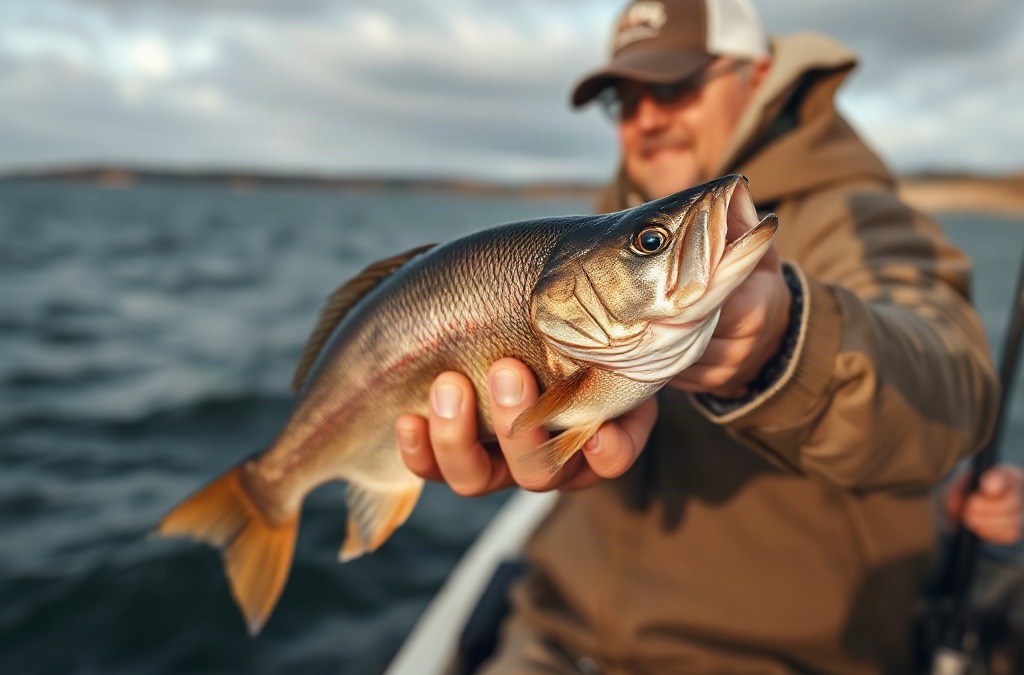
Adjust your fishing style based on the season by matching bait size, presentation speed, fishing depth, and daily timing to changing water temperature and fish behavior. In spring, work warming shallows with smaller offerings; in summer, target cooler water during low-light periods; in fall, follow concentrated baitfish with active presentations; and in winter, slow down near stable deep-water cover. Treat these as starting points rather than rigid rules because weather fronts, water clarity, current, and spawning cycles can temporarily override the calendar. If strikes stop, change depth or speed before replacing every lure in your tackle box.
What you’ll learn
This guide covers the following practical points:
- Read Water Conditions Before Following the Calendar — Seasonal labels describe broad patterns, but water conditions determine what fish experience on a particular day.
- Spring: Follow Warming Water and Staging Fish — Spring fishing revolves around uneven warming and movement toward spawning areas.
- Summer: Manage Heat, Light, and Oxygen — Summer fish commonly organize around tolerable temperature, adequate oxygen, food, and relief from bright light.
- Fall: Track Bait Movement and Feeding Windows — Fall favors anglers who locate forage rather than repeatedly visiting productive summer cover.
Read Water Conditions Before Following the Calendar
Seasonal labels describe broad patterns, but water conditions determine what fish experience on a particular day. A cold April morning in a deep reservoir may fish more like late winter, while several sunny days can warm a shallow pond enough to trigger spring movement. Begin by noting water temperature if you can measure it, then assess clarity, current, wind, recent weather, and the depth at which bait or fish appear.
Temperature changes metabolism and influences how quickly many fish will pursue food. Light affects where they feel comfortable feeding, while oxygen can make otherwise attractive water unproductive. Current positions river fish behind breaks, along seams, and near depth changes where they can feed without fighting the full flow. These factors explain why simply tying on a so-called seasonal lure can fail even when the lure choice seems reasonable.
Use a compact sequence before making large tackle changes:
- Check position: Test shallow, mid-depth, and deeper holding water rather than assuming fish are on the bank or bottom.
- Adjust speed: Make several controlled retrieves ranging from steady and active to slow with pauses.
- Match visible food: Compare your offering with local minnows, insects, crayfish, or other forage in size and general profile.
- Account for exposure: Prioritize shade, windblown cover, current breaks, or low-light periods when open water is bright.
- Record evidence: Note the depth, cover, retrieve, and time associated with every follow, missed strike, or landed fish.
A common mistake is changing lure color after every empty cast while continuing to fish the wrong depth. Depth and location usually deserve attention before fine distinctions such as two similar colors. If a lure is occasionally contacting cover, drawing follows, or producing light taps, its route is probably close to productive. If there is no sign of life after covering a distinct area thoroughly, move or test another depth band.

This evidence-first process makes how to adjust your fishing style based on the season a practical decision rather than a calendar-based guess. Keep the seasonal pattern as a starting hypothesis, then let each cast confirm or challenge it.
Spring: Follow Warming Water and Staging Fish
Spring fishing revolves around uneven warming and movement toward spawning areas. Shallow coves, dark bottoms, protected banks, and incoming water may warm sooner than the main basin. Fish often use nearby points, channel edges, submerged vegetation, or the first substantial drop as staging areas before moving shallower. A warm afternoon can improve shallow activity, whereas a cold front may push fish back toward the closest depth change without sending them far away.
Start near transition routes instead of racing directly to the shallowest cover. Work an offering from the bank or flat toward deeper water so it passes both active fish and those holding off the edge. Small swimbaits, suspending minnows, soft plastics, jigs, live bait where permitted, and slowly retrieved spinners can cover different levels without requiring an oversized presentation. The exact choice should reflect the species, local forage, and snag risk.
Presentation speed should respond to the trend, not merely the month. During stable warming weather, a moving lure can locate scattered fish. After a sharp temperature drop, a compact bait held near cover or paused in the strike zone may be more effective. For example, a fish that will not chase a fast spinner across a chilly flat may still take a soft plastic worked down the adjacent break. That change preserves the location theory while adapting the amount of effort required from the fish.
Spawning behavior also requires restraint. Rules, closures, and protected areas vary, so check the regulations for the water being fished. Avoid disturbing visible nests where restrictions or conservation concerns apply, and handle any fish promptly. Spring does not mean every individual is spawning at once; water depth, elevation, species, and local temperature create overlapping pre-spawn, spawning, and post-spawn groups.
The usual spring failure is treating one warm afternoon as proof that all fish have moved shallow. Search the warmest suitable water, but keep a nearby staging route in the plan. Signs that the adjustment is working include follows, bait activity, repeated bites from a depth edge, or fish contacted along several similar banks. If shallow water looks lifeless and the temperature has recently fallen, back out one structural step before abandoning the area.
Summer: Manage Heat, Light, and Oxygen
Summer fish commonly organize around tolerable temperature, adequate oxygen, food, and relief from bright light. Early morning, evening, and overcast periods may bring predators onto flats or toward the surface. Under strong midday sun, many move deeper, tuck beneath vegetation, hold in shade, or settle near current that delivers oxygen and prey. The useful adjustment is often a change in time and position rather than a completely different tackle collection.
During low light, topwater lures, shallow-running baits, flies, or live offerings can intercept active fish near shore and over submerged cover. As sunlight strengthens, work the outside weed edge, dock shade, bridge shadows where access is legal, deeper points, or the down-current side of structure. In rivers, avoid assuming the deepest pool is automatically best; a moderate-depth seam with current and cover may offer better feeding conditions than still, warm water.
Depth deserves careful interpretation in lakes that separate into warmer and colder layers. Very deep water is not necessarily productive if oxygen is limited there, and species differ in their temperature and oxygen preferences. Electronics can reveal suspended fish or bait, but the screen should guide casting rather than replace it. When marks appear at a consistent depth, choose a lure that stays in that zone instead of repeatedly passing several feet above or below it.
Summer also creates a tradeoff between fast searching and precise fishing. A crankbait or spinner can locate active fish along a long weed line, while a weighted soft plastic, jig, or natural bait can probe compact shade and holes in vegetation. Begin with the faster approach when fish appear scattered and conditions are comfortable. Slow down only after finding a productive feature or when heat and heavy recreational activity reduce visible movement.
Anglers often fail by fishing comfortable hours rather than productive ones. If every trip begins at noon, seasonal conclusions may be distorted by light and boat traffic. Shift one outing to dawn or late evening and compare results. During hot weather, monitor yourself as carefully as the water: carry drinking water, use sun protection, watch changing weather, and leave exposed water when thunderstorms threaten. A catch is never worth delaying a safe return.
Fall: Track Bait Movement and Feeding Windows
Fall favors anglers who locate forage rather than repeatedly visiting productive summer cover. Cooling water can move baitfish toward creek arms, shallow flats, current corridors, or other areas where food concentrates. Predators may roam more widely and feed in shorter, conspicuous bursts. Birds watching the water, surface disturbance, flickering bait, and repeated marks on electronics can all indicate where the food chain is gathering.

Moving presentations become useful search tools when fish are dispersed. Medium-diving plugs, spoons, swimbaits, spinners, streamers, or baitfish rigs can cover water at a controlled depth. Match the approximate forage size before obsessing over exact color. If local bait is small, a large profile may draw attention but reduce committed strikes; a closer size match often produces a more natural target. In stained water, vibration or contrast can matter more than a detailed finish.
Do not interpret fall feeding as permission to retrieve everything quickly. Speed should match the fish you observe. Aggressive surface activity supports a brisk presentation through or beside the bait, while inactive fish beneath a school may respond to a lure allowed to sink and travel below it. Casting directly into a tightly packed bait ball can make an artificial hard to distinguish. Working its edge, underside, or escape route often presents a clearer opportunity.
Cold fronts and rapidly falling temperatures can interrupt an otherwise strong pattern. When surface action disappears, check the nearest drop, channel turn, standing timber, or deeper end of the same flat. The fish may have shifted vertically rather than left the area. This is where a seasonal adjustment differs from random lure rotation: the angler follows the relationship between bait, structure, and weather.
A productive fall plan alternates searching with verification. Cover water until bait or a strike reveals a useful zone, then repeat the same depth and structural relationship elsewhere. If the pattern only works during a brief evening window, arrive early enough to identify safe casting positions and likely travel routes. The detailed process behind how to adjust your fishing style based on the season is less about owning autumn-specific tackle and more about recognizing when mobile feeding replaces the stable summer pattern.
Winter: Slow the Presentation Without Fishing Passively
Winter calls for precision, longer pauses, and attention to stable holding areas, but it does not require leaving a lure motionless everywhere. Colder water commonly reduces sustained pursuit, so fish may cluster near deep structure, channel edges, remaining vegetation, current breaks, or small areas with favorable temperature and forage. Covering unproductive water very slowly wastes time; locate promising structure first, then reduce speed.
Compact jigs, drop-shot rigs, blade baits, small spoons, soft plastics, flies, or natural bait can maintain depth with limited forward movement. Choose according to species, local rules, bottom composition, and the amount of cover. A heavy lure reaches deep water efficiently but may bury in soft bottom or snag wood. A lighter offering falls more naturally, although wind and current can make contact difficult. The best weight is the lightest one that still lets you detect bottom, maintain the target depth, and recognize subtle bites.
Boat control and casting angle become especially valuable. Wind can move a boat faster than a slow presentation is intended to travel, while bank anglers may need to cast along a drop rather than straight across it. In a river, placing a lure upstream and allowing it to enter a current seam can look more natural than repeatedly dragging it against the flow. Small angle changes can extend the time spent in the productive zone without changing the bait.
The phrase “fish slowly” is often applied too broadly. If twenty minutes of careful work produces no contact, verify depth and location instead of slowing further. A working winter approach usually produces repeatable signs: multiple bites near the same depth, contact at a particular piece of cover, or activity during the warmest part of a stable day. A failing approach produces no feedback across several suitable targets.
Cold water raises safety concerns that outweigh tactical choices. Wear appropriate flotation when boating, dress for immersion risk rather than air temperature alone, and avoid unstable ice. Ice thickness and condition can vary over short distances and change with current, springs, weather, and access activity; consult local authorities or experienced local operators rather than relying on a universal number. When open-water conditions are unsafe, postponing the trip is the correct seasonal adjustment.
Frequently Asked Questions
What fishing variable should I change first when seasons shift?
Change the depth and location you are covering before making small lure changes. Once fish or forage are found, refine retrieve speed, profile, color, and weight.
Should I always retrieve lures slowly in cold water?
No. Use enough movement to search likely structure, then slow down near fish. Water clarity, current, species, and recent temperature trends can make a moderate retrieve more productive than an extremely slow one.
What is the best time of day to fish in summer?
Dawn and evening often offer cooler conditions and lower light, but shade, current, cloud cover, and deep structure can support midday opportunities. Compare time windows on the same water.
Why do productive spring shallows suddenly stop producing?
A cold front, falling water, increased clarity, or disturbance may move fish to the closest drop or heavier cover. Test the adjacent staging area before leaving that part of the lake or river.
Do I need different fishing gear for every season?
Usually not. A versatile rod-and-reel setup can handle multiple seasons if you carry lures or rigs that cover different depths, speeds, and forage sizes. Specialized gear becomes useful for extreme depth, heavy cover, ice, or particular species.
Conclusion
Seasonal success comes from recognizing which part of the water currently combines food, comfort, cover, and a practical feeding opportunity. Use spring warming trends, summer shade and oxygen, fall forage movement, and winter stability as working patterns—not inflexible rules. On each trip, test depth and position first, retrieve speed second, and lure details after you have evidence that fish are nearby.
Keep brief notes on weather, water conditions, productive depth, cover, and time. Those observations will expose local patterns that a general seasonal calendar cannot provide. When a pattern fails, move to the nearest logical alternative rather than replacing tackle at random. Check local regulations, account for weather and cold-water hazards, and let safe access determine whether a promising seasonal opportunity is worth fishing.

