
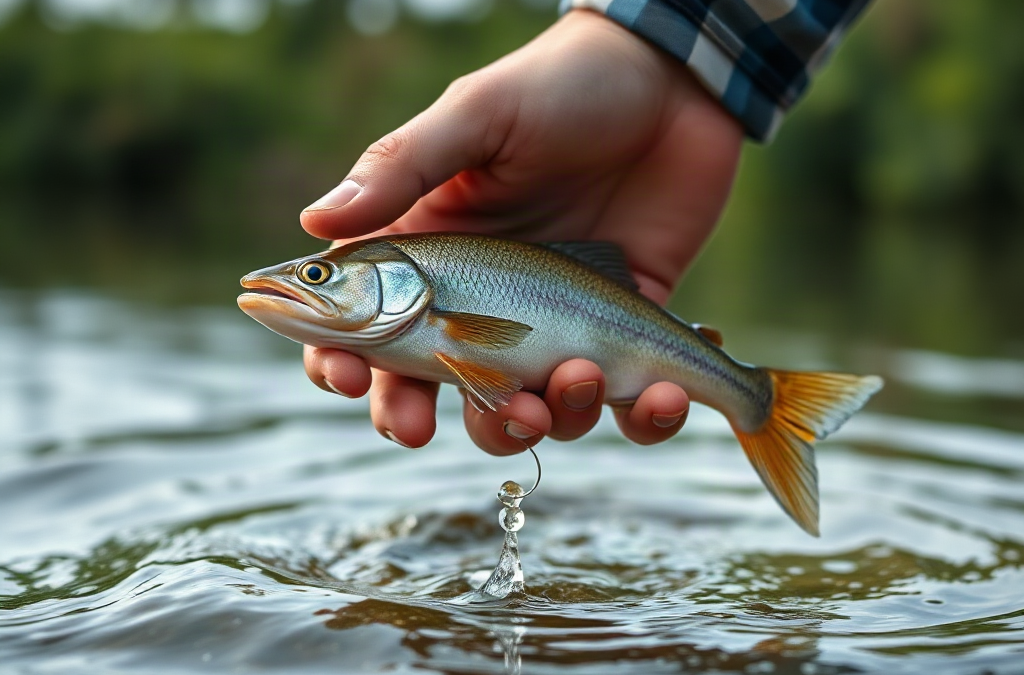
If you catch a fish that's too small, keep it in the water when possible, wet your hands before touching it, remove the hook promptly, and release it unless local regulations permit and you intend to keep it. Use pliers to back out an accessible hook without squeezing the fish or touching its gills. If the hook is deeply embedded, cutting the line close to the hook may cause less injury than prolonged extraction. Support the fish horizontally, revive it in clean water if needed, and let it swim away under its own power. Always confirm species-specific size, season, and possession rules for the water you are fishing.
Confirm Whether the Fish Must Be Released
An undersized fish generally must be returned immediately when the applicable fishing rules establish a minimum legal length. The controlling rule may depend on the species, body of water, season, fishing method, and management zone. Do not assume that a size limit remembered from another lake, river, or coastal area applies where you are standing.

Check the current regulations before fishing and keep them accessible on the water. Printed rulebooks, an official wildlife-agency website, or an agency fishing application may identify minimum lengths, protected length ranges, closed seasons, and daily possession limits. Some rules prohibit keeping fish below a minimum length, while slot limits protect fish within a specified range. A fish can therefore be too small to retain under one rule, legally retainable under another, or protected regardless of size during a closed season.
Measure only when the fish is close enough to the legal threshold that a measurement is necessary. Use a rigid or clearly marked measuring board suitable for the species. Place the fish in the position required by local rules, because agencies may specify whether the mouth is closed, the tail is pinched, or total length rather than fork length controls. A soft tape following the body can produce a longer and unreliable reading. If a fish is plainly short, measuring it on a hot or abrasive surface only extends handling time without changing the decision.
For example, an angler may catch a fish that appears close to a 12-inch minimum. Estimating against a rod handle is a weak substitute for a proper board, particularly if the mark was never verified. If an accurate measurement does not clearly establish legality, releasing the fish is the safer compliance decision. Never stretch, flatten, or manipulate a fish to force a marginal reading.
Rules may also restrict removing certain protected species from the water. That makes identification part of the decision. Notice body shape, fin placement, coloration, mouth position, and other distinguishing features before assuming the catch is a familiar species. When identification is uncertain, minimize handling, take a quick photograph only if doing so is lawful and does not delay release, and return the fish. The practical priority behind what to do if you catch a fish that’s too small is not finding a reason to keep a borderline catch; it is making a prompt, defensible decision under the rules that govern that location.
Handle an Undersized Fish Without Causing Avoidable Harm
Low-contact handling gives a small fish the strongest chance of swimming away in good condition. Fish have a protective surface coating, delicate gill tissue, and bodies supported by water. Dry hands, rough ground, excessive pressure, and extended air exposure can damage tissue even when the fish appears active at release.
Leave the fish in the water while organizing the release whenever conditions allow. If you must lift it, wet your hands first and support it gently rather than gripping it tightly. Hold a small fish around the body only with enough control to prevent dropping, keeping fingers away from the gill openings and eyes. Larger or elongated fish need horizontal support under the belly; hanging them solely by the jaw can place unnecessary strain on the jaw and internal structures.
Prepare before the first cast. Keep needle-nose pliers or hemostats within reach, open the landing net, and place a measuring board where it can be used immediately. A rubberized or knotless net is generally less abrasive and less likely to entangle fins and hooks than coarse knotted mesh. Readiness matters because a fish should not remain on a deck while an angler searches through a tackle bag.
Consider a common bank-fishing scenario: a small fish lands on gravel several feet from the water because it was swung ashore. The hook may come out easily, yet the fish has already been exposed to abrasive stones and a longer return trip. Guiding it into shallow water or using a suitable net keeps the release controlled. From a boat, the corresponding mistake is placing it on a dry, sun-heated deck. Unhooking over the water or above a wet net limits both contact and the consequence of a sudden flop.
A compact handling checklist keeps the sequence clear:
- Control the line: Prevent the fish from thrashing against rocks, rails, or equipment.
- Wet contact surfaces: Wet hands, a cradle, or a measuring board before use.
- Avoid sensitive areas: Do not insert fingers beneath the gill covers or squeeze the abdomen.
- Keep the release brief: Have tools ready and skip unnecessary photographs.
- Prevent falls: Work close to the water rather than standing with the fish at chest height.
Gloves are not automatically gentler. Dry fabric can remove more protective coating than clean, wet hands, while specialized wet fish-handling gloves may be useful around teeth, spines, or sharp hooks. Personal safety still matters: if a fish has strong spines or teeth, use an appropriate net and gripping tool without suspending the fish longer than necessary. The goal is controlled handling, not bare-handed handling at any cost.
Remove the Hook and Return the Fish Safely
Hook removal should be quick, controlled, and based on where the hook is lodged. For a hook sitting visibly in the lip, reduce line tension, hold the fish securely, and use pliers to reverse the hook along the path by which it entered. Pulling in a new direction can enlarge the wound or tear tissue.
Barbless hooks usually back out faster than barbed hooks, which can reduce handling time during catch-and-release fishing. Anglers can buy barbless patterns or flatten a conventional barb with pliers where regulations allow. The tradeoff is that maintaining steady line tension becomes more important while fighting the fish. That inconvenience is often worthwhile when small or protected fish are likely to be encountered repeatedly.
A deeply swallowed hook creates a different decision. Reaching into the throat, twisting blindly, or repeatedly pulling against resistance can cause more damage than leaving the hook in place. If safe removal is not possible, cut the leader or line as close to the hook as you can without injuring the fish. Regulations for particular waters or species may provide more specific instructions, so follow those requirements first. Do not use the possibility that a hook may eventually corrode as an excuse for careless rigging; the immediate objective is to avoid severe additional injury.
Treble hooks require extra control because an exposed point can catch the fish, net, clothing, or angler while another point remains embedded. Keep the fish supported in the net, control the lure with pliers, and free one point at a time. If the situation becomes unsafe, cutting a hook point with suitable cutters may be preferable to forcing the lure. Carrying cutters is especially sensible when using plugs with multiple trebles.

Return the fish to water matching the area where it was caught rather than throwing it from a height. Place it upright with its head facing into gentle current, or hold it loosely in still water so water can move through the mouth and across the gills. Do not pump it rapidly backward and forward; backward movement does not pass water over the gills in the normal direction. Release your support when the fish maintains balance and tries to swim away.
A fish that rolls onto its side, cannot hold itself upright, or repeatedly drifts back is not ready to be abandoned. Continue gentle support in clean, well-oxygenated water if conditions are safe. Conversely, restraining a vigorous fish after it is trying to leave adds needless stress. A successful release is indicated by stable posture, purposeful movement, and the ability to swim away without being pushed. The most useful account of what to do if you catch a fish that’s too small recognizes that hook location and fish condition—not the desire for a photograph—should determine how long the process takes.
Adjust Your Tackle When Small Fish Keep Biting
Repeated catches of undersized fish usually call for an adjustment rather than repeated handling of the same size class. Small fish may be concentrated around shallow cover, a particular depth, a bait source, or a spawning and nursery area. Moving a short distance or changing presentation can reduce encounters more effectively than simply casting to the same spot again.
Start with location. If every cast near a shallow weed edge produces juvenile fish, try the deeper outside edge, a nearby drop-off, stronger current seam, or structure farther from the bank. The appropriate move varies by species and season, but the reasoning is consistent: different sizes often use different portions of available habitat. A move does not guarantee larger fish, and sometimes the entire active population is small. After several similar catches, changing water is usually more responsible than continuing to hook fish that must immediately be released.
Lure and hook selection can also influence which fish are caught, though increasing size is not a perfect filter. A slightly larger lure may discourage the smallest individuals while remaining manageable for legal fish. A larger hook must still match the bait and the mouth size of the intended species; an oversized hook can impair presentation without preventing aggressive juveniles from striking. Switching from bait that small fish can swallow quickly to a lure retrieved more actively may produce shallower hook placement and easier releases.
Circle hooks may reduce deep hooking in some bait-fishing situations when they are appropriate and used correctly. Rather than making a hard hookset, the angler generally allows the line to tighten and the hook to move toward the corner of the mouth. They are not a universal solution: hook design, bait rigging, species, and local regulations all matter. With any hook style, attending the rod and responding promptly can reduce the time a fish has to swallow bait.
Depth of hook placement is a useful sign that an approach is failing. If several small fish are swallowing hooks, change the rig, use a more suitable hook, alter bait size, hold the rod instead of leaving it unattended, or leave the area. If subsequent fish are hooked cleanly near the mouth—or small-fish encounters stop—the adjustment is working. Continuing unchanged because each individual fish swims away overlooks the cumulative effect of repeated captures.
Plan for release before choosing tackle. Carry pliers, a line cutter, and a measuring device; replace coarse nets; and consider single hooks where they suit the lure and rules. These choices cannot eliminate all injury, but they reduce predictable delays and make lawful release easier when an undersized catch occurs.
Frequently Asked Questions
Can I keep a fish that is only slightly under the legal size?
No. If a minimum length applies, a fish below it is generally not legal to retain, even when the difference is small. Measure it using the official method and release it promptly if it does not clearly qualify.
Should I remove a deeply swallowed hook?
Do not force a hook out when removal would tear the throat or gills. Cut the line close to the hook unless local rules or species-specific guidance require another procedure.
Is it safe to touch a small fish with bare hands?
Clean, thoroughly wet hands are usually less abrasive than dry hands or dry fabric. Use gentle pressure, avoid the gills and eyes, and return the fish quickly.
How long can a fish stay out of the water during release?
Keep air exposure as short as possible rather than relying on a fixed time. Organize tools first, unhook the fish near or in the water, and skip photographs if the fish is struggling.
Will a larger hook stop undersized fish from biting?
Not reliably. A modestly larger, properly matched hook or lure may reduce some small catches, but changing location, depth, bait, or presentation is often more effective.
Conclusion
An undersized catch should trigger a fast sequence: identify the species, apply the correct local length rule, measure only when necessary, and minimize contact during release. Wet hands, ready pliers, an appropriate net, and a reliable measuring board prevent delays that commonly occur when anglers improvise. Accessible lip hooks can usually be backed out cleanly, while a deeply embedded hook may call for cutting the line instead of forcing removal.
Pay attention to what happens after release and during the next few casts. A fish that cannot remain upright needs brief support in the water, while repeated deep-hooked juveniles signal that the rig, bait, response time, or location should change. Before your next trip, review the current rules for the exact water, organize release tools where they can be reached immediately, and select tackle with both the target fish and likely undersized catches in mind.

